
Selling CBD in the United States is not just about great products and branding rather it’s about navigating complex laws that change from state to state. So a CBD product which is easy to sell legally in one state online or in-store might be restricted, may have a new formula or be completely banned in another state.
If you are building a CBD brand, launching a CBD ecommerce store, or stocking CBD products in your retail shop, it is essential to understand how state-by-state CBD regulations work, and not just federal rules.
This State-by-State Guide to Selling CBD Online and In-Store is designed to help you make smarter and safer decisions. Through this blog we will throw light on how the 2018 Farm Bill shaped hemp-derived CBD, what the FDA still does not allow, and how states have their own rules about CBD gummies, tinctures, topicals, beverages, vapes, and smokable hemp.
You will learn where CBD retail is relatively straightforward, where CBD ecommerce requires strict shipping rules, and where only 0% THC or very limited products are allowed.
Whether you are a new CBD startup, or an established wellness brand, or a physical store retailer adding CBD to your shelves, this blog will help you:
- Understand key differences in state CBD laws
- Avoid common compliance mistakes while selling CBD online
- Set up practical policies for in-store CBD sales and age verification
The goal is not to scare you away from the market rather it’s to give you clarity. When you know the rules, you can scale your business into new states confidently, protect your business, and build long-term trust with customers who care about safety, legality, and transparency in every CBD product that they buy.
Federal Law: The Ground You’re Standing On
The 2018 Farm Bill and Hemp-Derived CBD
The modern CBD industry really begins with the 2018 Agriculture Improvement Act, known as the 2018 Farm Bill. This law removed hemp from the federal Controlled Substances Act and created a legal distinction between hemp and marijuana.
Under federal law, hemp is defined as cannabis(and any extracts, including CBD) that contains no more than 0.3% delta-9 THC on a dry-weight basis.
Anything exceeding that limit is still classified as marijuana and treated as a Schedule l controlled substance under federal law.
For CBD sellers, this means your products are only considered “hemp-derived CBD” and not a controlled substance if:
- The CBD comes from legally grown hemp under a state or federal hemp program.
- The finished product contains 0.3% delta-9 THC or less on a dry-weight basis.
- The hemp is cultivated and processed by licensed growers and processors under an approved plan.
When those conditions are met, hemp-derived CBD is not treated as a federally controlled drug. That change made it possible for hemp-derived CBD to be legal in all 50 states but only as a baseline framework at the federal level. States are still allowed to have extra rules and restrictions which is why a state-by-state strategy is essential.
Also Read: Is CBD Legal in All 50 States
The FDA’s Position on CBD in Food, Beverages, and Supplements
Even though the Farm Bill made hemp-derived CBD non-controlled at the federal level, the FDA(U.S. Food and Drug Administration) still controls how CBD can be used in foods, beverages, supplements, and health products.
The FDA’s current position is cautious and restrictive in several key areas:
- CBD cannot be marketed as a dietary supplement. Since CBD is already used and approved as an active ingredient in a prescription drug, the FDA says it can’t also be marketed as a dietary supplement under current law.
- CBD is not allowed as an additive in food or drinks sold in interstate commerce. It means a beverage or snack infused with CBD shipped across state lines, it’s technically a violation of federal food regulations even though you will still find plenty of those products on shelves and online.
- No medical or therapeutic claims without drug approval. Marketing CBD products with claims such as “treats anxiety,” “reduces pain,” or “helps cancer patients” can quickly draw enforcement action. Statements like these push your product into the “drug” category, where you are expected to have formal approval and strong clinical evidence to back them up.
In reality, CBD oils, gummies, drinks, and capsules are sold almost everywhere, but from a legal standpoint they still are in a gray zone. Smart CBD brands focus on wellness, relaxation, and general support language, while deliberately avoiding any words like it’s treating separate specific diseases.
Also Read: Selling CBD Products Online
Shipping CBD Across State Lines
The 2018 Farm Bill clarified that hemp and hemp products can be shipped across state lines, which is crucial for CBD ecommerce and wholesale. However, if you overlook two key exceptions, you can still create serious problems:
1. Receiving state laws still apply
Federal law allows the shipment, but each state can still limit how CBD is sold or what forms are legal. For instance, a full-spectrum CBD gummy which is fine in one state might violate THC limits or edible rules in another.
If a state bans certain product types like smokable hemp or CBD edibles or requires 0% THC, shipping those products there can still be illegal under state law, even if federal law allows the shipment of hemp generally.
2. Carriers have their own policies and documentation requirements
Major carriers don’t just follow federal law rather they also enforce their own rules for shipping CBD. USPS, UPS, FedEx, and private couriers often require proof that your products are truly hemp-derived along with up-to-date Certificates of Analysis(COAs) confirming that they contain no more than 0.3% delta-9 THC.
Some may also ask for copies of your business licenses or hemp registrations before they are comfortable handling your shipments. If a package looks suspicious, lacks proper paperwork, or appears to violate their internal policies, they can delay it, return it, or even seize it outright.
For CBD businesses, it means ecommerce is absolutely possible, but it can’t be treated casually. Your online operation has to be built on compliance and not just convenience knowing the rules at both the federal and state levels, and make sure your shipping processes, product labels, and documentation all line up with what regulators and carriers expect.
Also Read: How to Get a CBD License
Core Compliance Pillars for CBD Sellers (Any State)
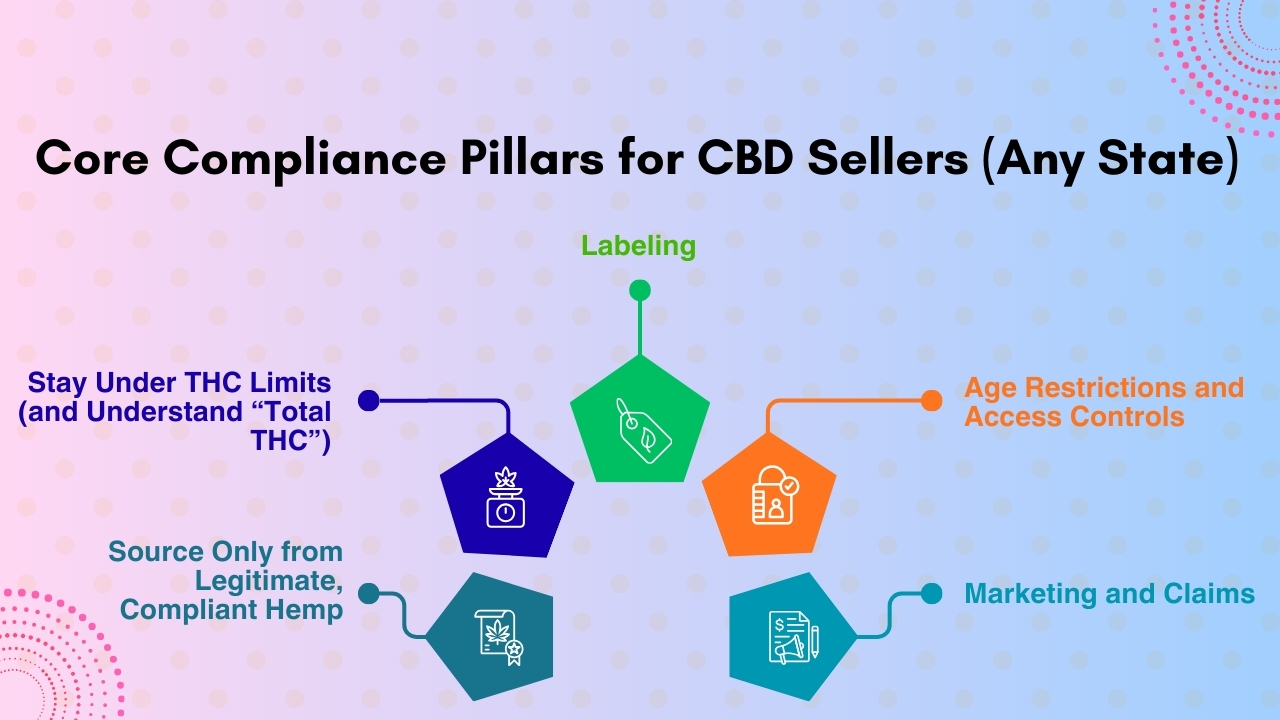
Before you even worry about specific states, make sure that you are aligned with the fundamentals. These apply whether you are selling online, at a farmer’s market, or in a large retail chain.
1. Source Only from Legitimate, Compliant Hemp
Your risk level drops instantly when you start with clean, legal inputs. Work only with licensed hemp growers and processors who can clearly document their legal status.
For every batch, demand Certificates of Analysis(COAs) from accredited labs that detail potency(CBD and THC levels), residual solvents, heavy metals, pesticides, and microbials.
Store COAs in an organized way and highly visible – for instance, link them on each product page and add a scannable QR code on the label so customers and regulators can access them instantly. When an inspector arrives, quickly producing the COA for any batch can immediately create confidence and set a positive tone for the entire inspection.
Also Read: How Much Does an Average CBD Store Make
2. Stay Under THC Limits (and Understand “Total THC”)
Federal hemp law focuses on a 0.3% delta-9 THC dry-weight limit, but states increasingly look at “total THC”(delta-9 plus THCa) and set per-serving or per-package caps for edibles and beverages. As you expand into new markets, a product that passes in one state can suddenly fail the rules in another.
Ensure you build your product development and lab review process across the strictest THC framework you plan to operate under. This helps you avoid the hassle of reworking your formulas or updating packaging every time you launch in new markets.
Also Read: How to Open a CBD Dispensary in California
3. Labeling
Your label is both a marketing asset and a legal document. At minimum, include product identity(for instance, “Hemp-Derived CBD Oil”), total CBD per package and per serving, net contents, full ingredient list, manufacturer or distributor name and address, batch or lot number, and manufacture date.
Add suggested use and relevant warnings but avoid disease claims or over-promising “functional” language. The more your packaging and messaging resemble a pharmaceutical drug, the more likely you are at the risk of FDA and FTC enforcement.
Also Read: CBD Business Name Ideas
4. Age Restrictions and Access Controls
Many states now set 18+ or 21+ rules for particular CBD formats (such as vapes, smokables, or intoxicating hemp products). Some states also limit where your products are allowed to be sold.
Integrate age verification into your online store(with age gates and checkout checks) and train your retail team to reliably check IDs for any higher-risk product lines. Handle it the same way you would alcohol ID checks – strict, documented, and non-negotiable.
5. Marketing and Claims
Regulators care less that you sell CBD and more about what you promise it will do. If you make any claim then it must be truthful, not misleading, and should have solid evidence.
Avoid any disease claims or drug comparisons . Instead use simple wellness language: “supports relaxation,”. You can still highlight benefits while staying safely away from making unapproved drug-style claims.
Also Read: Marketing Ideas for CBD Business
Understanding the Patchwork: How States Classify CBD
States regulate CBD across a few key areas: which product types are allowed(such as oils, gummies, drinks, vapes, smokable hemp), where they can be sold(only in dispensaries, specialty shops, or general retail), who can purchase them(with 18+ or 21+ age limits), and whether certain forms especially smokable hemp are outright banned or heavily restricted.
In practice, it creates three broad categories:
- Broadly CBD-friendly states, these are the states where CBD is widely available and the focus is on testing, labeling, age limits, and general consumer safety.
- States that allow CBD with extra restrictions, where certain categories such as foods, drinks, or smokables may be prohibited or only allowed under specific conditions.
- The most restrictive states, where CBD sales are heavily limited, THC must be essentially 0%, or only narrow medical programs exist.
For CBD brands, the takeaway is simple: you can’t assume what is allowed in your home state will be allowed everywhere. Before launching a product in a new state, you need to confirm how that state classifies CBD, what forms are permitted, and what extra rules might apply. Consider it as a compliance checklist which is not a guess and update that checklist regularly as laws evolve.
Also Read: How to Choose the Right CBD Merchant Account
State-by-State Guide (Grouped Overview, 2025)
Laws around hemp-derived products especially delta-8, THCa, and high-THC beverages) are changing constantly. Always confirm details with current state law or a qualified attorney before launching or shipping.
States Generally Friendly to Over-the-Counter CBD
In these states, hemp-derived CBD with less than 0.3% delta-9 THC is widely available both online and in physical retail. The core focus is usually testing, accurate labeling, and age rules, rather than outright bans.
What it looks like in practice
- California and other large markets commonly allow hemp CBD in wellness shops, supplement stores, and even major retail chains. At the same time, emerging regulations are tightening control over intoxicating hemp products such as high-THC seltzers or delta-8 gummies) and pushing them out of general retail into licensed cannabis channels.
- States like Colorado, Oregon, and Washington where cannabis laws are well established generally permit hemp derived CBD but are steadily introducing potency limits and more detailed rules for hemp-derived THC products.
- In places like Illinois, Michigan, and Massachusetts, recreational cannabis is legal and hemp-derived CBD is generally easy to sell as long as you stay under 0.3% delta-9 THC and follow testing and labeling requirements.
- New York and New Jersey treat CBD as broadly legal but regulated. New York, for instance, has specific “cannabinoid hemp” programs with defined lab testing, packaging, and marketing requirements.
Also Read: Understanding CBD Payment Terms
What this means for selling CBD here
- Online: In most of these states, you can safely ship typical CBD staples such as oils, capsules, topicals, and moderate-strength gummies without much friction. Problems usually begin with high-THC hemp drinks, delta-8 or similar derivatives, and any product marketed as clearly intoxicating or recreational especially when combined with bold or misleading promotional claims.
- In-store: In physical retail, the rules tend to be stricter and more visible. You will often be required to stock only products sourced from licensed or state-registered hemp producers, with documentation available if inspectors ask. Certificates of Analysis(COAs) should be accessible in-store either via QR codes printed on labels or in a clearly organized folder behind the counter. Beyond that, many states also set age limits like 18+ or 21+. Also train your staff to check IDs every time and clearly understand which products are age-restricted and who is allowed to buy them.
Also Read: How to Advertise CBD On Instagram
States That Allow CBD but Restrict Certain Products
The second group of states takes a “yes, but” approach: CBD is allowed, yet specific product categories are banned or strictly controlled. These rules frequently target inhalable or smokable hemp, CBD products sold in gas stations, and CBD-infused foods and beverages.
Common restriction patterns
- Louisiana allows CBD but bans inhalable hemp products such as flower and some vapes. Certain locations such as gas stations are limited in what CBD items they can sell.
- North Dakota and similar states may allow CBD in some formats but prohibit edibles or infused drinks under particular regulations even while other forms (for instance, oils or topicals) are allowed.
- Iowa, Minnesota, and other Midwestern states frequently use strict THC limits per serving and per package, especially for beverages and edibles. For instance, hemp drinks may have to stay under very low milligram limits for total THC.
- Texas, a rapidly evolving market, allows hemp-derived CBD broadly, but legislators repeatedly introduce bills targeting hemp-derived THC products.
If any of those measures take effect, full-spectrum gummies and beverages could quickly find themselves subject to new restrictions or outright bans.
Also Read: How to Avoid Frauds and Chargebacks in CBD Payment Processing
What this means for selling CBD here
- Online: Configure your ecommerce platform so that restricted SKUs like smokable hemp or high-THC beverages are automatically blocked from shipping to certain states. Use address-based shipping rules and a clearly defined, regularly updated “no-ship” list by product type and state.
- In-Store: In restricted states, guessing is not a strategy rather you need a clear, written understanding of exactly what is allowed. Clarify whether you can sell only topicals, allowed to sell oils but not edibles, or edibles with strict THC limits, then put those rules into a simple product sheet for your team to refer to.
The Most Restrictive States (0% THC & Narrow Allowances)
Some states are far more conservative about CBD, particularly when it comes to any detectable THC, especially around any detectable THC – treating even trace amounts as an issue and enforcing rules that sharply restrict full-spectrum or mildly intoxicating hemp products.
Key examples
- Idaho has historically been one of the strictest CBD states. Hemp-derived CBD is typically only allowed if it contains 0% THC and not merely under 0.3%. Even trace amounts in a “full-spectrum” product can be a problem.
- Kansas follows a similar pattern: CBD products generally must contain no detectable THC, which effectively rules out most full-spectrum CBD products and pushes brand toward broad-spectrum or isolate.
- Nebraska, and a few states like it, have debated or introduced legislation that would criminalize or severely restrict many hemp-derived THC products, including full-spectrum CBD items with trace THC. The exact status can shift as bills move, stall, or get amended.
In these states, your standard full-spectrum range – especially gummies, drinks, and higher-strength tinctures – becomes extremely difficult to sell unless you reformulate.
Also Read: How to Expand Your CBD Business to New Market
What this means for selling CBD here
1. Product Strategy
For the most restrictive states, consider creating a dedicated “zero-THC” line built around CBD isolate or broad-spectrum extracts that consistently test with no detectable THC. Clearly tag these SKUs internally as “0% THC states” so operations, sales, and marketing don’t confuse them with your full-spectrum products.
2. Labeling & COAs
Expect regulators to look closely at your COAs in inspections or enforcement sweeps. Make sure lab reports from accredited labs clearly show not detected for THC when required. Only use claims like “0% THC” or “THC-free” when they are fully supported by test results and match the state’s technical definition of “zero.”
3. Channel and Risk Management
In these states, it can be smarter to offer a small, tightly controlled product line rather than your full catalog. Apply a simple rule: if THC is detectable, it does not ship there. Always weigh the cost of maintaining compliant 0% THC products against the actual market size and demand.
Also Read: Best Ecommerce Platform for CBD
Regional CBD Compliance Guide: Key Takeaways for Retailers
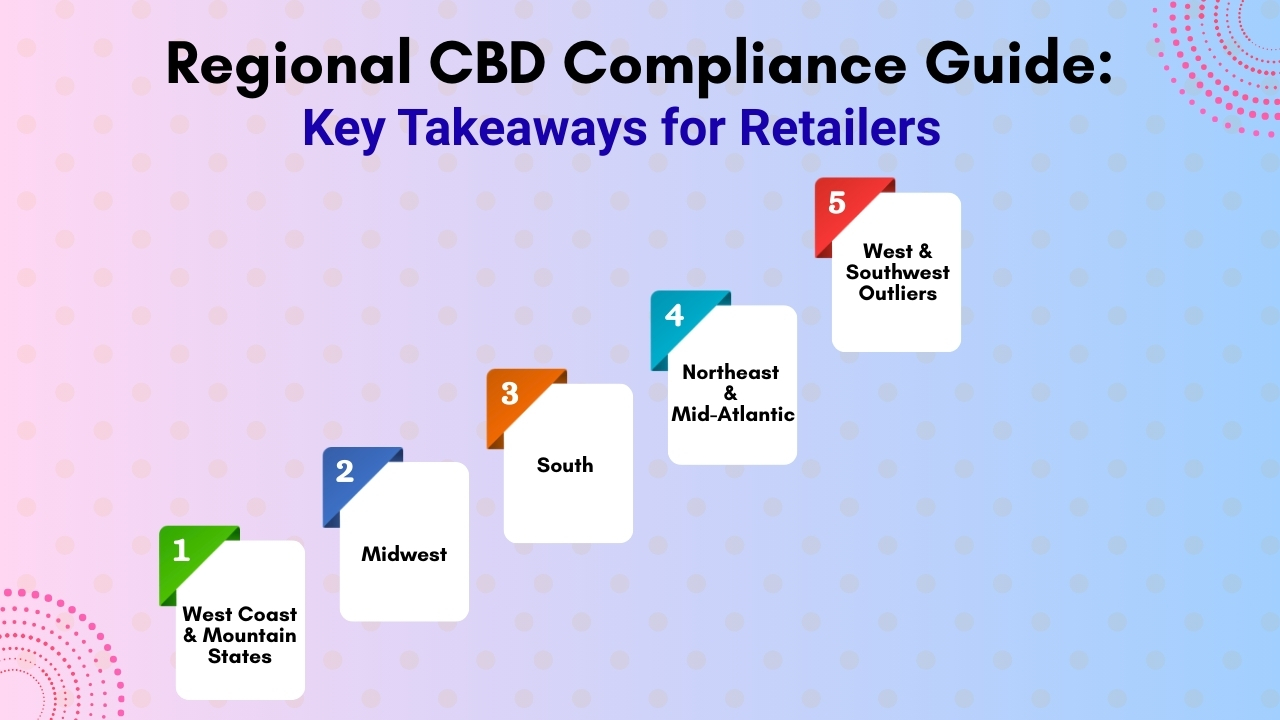
Across the United States, the regulatory environment tends to cluster into predictable zones, some highly CBD-friendly, others conditional, and a few extremely strict. Understanding these regional themes helps you predict risks, plan product assortments, and shape your operations more efficiently.
1. West Coast & Mountain States
These states like California, Oregon, Washington, Nevada, Colorado are generally CBD-friendly with established cannabis markets. Hemp CBD sells widely, but intoxicating hemp(delta-8, THCa flower, high-THC beverages) is facing increased bans or tighter regulation. Online markets are strong; in-store competition is tough and quality-focused.
2. Midwest
States like Illinois, Michigan, and Missouri are attractive because recreational cannabis is legal and CBD rules are relatively business-friendly.
In contrast, places such as Kansas and Nebraska are far more restrictive, often requiring 0% THC or banning certain product types altogether, such as edibles or smokable hemp.
3. South
It is a fast-growing but fast-changing region. Most Southern states allow CBD but impose bans on smokable hemp, THC limits on gummies and beverages, and age limits(often 21+). Also expect rapid regulatory shifts.
4. Northeast & Mid-Atlantic
The Northeast and Mid-Atlantic are generally CBD-friendly, but businesses still face strict, state-driven rules. Most states in this region have detailed hemp and cannabinoid rules, with strict requirements around product testing, COAs, and accurate labeling.
Regulators closely inspect packaging, especially anything that could attract children such as candy-like gummies or cartoon-style designs. For compliant brands, this region is a strong opportunity especially for online sales of tinctures, capsules, and wellness-focused products which can be clearly considered as adult, health-oriented supplements.
5. West & Southwest Outliers
In the West and Southwest, certain states are clear exceptions to the usual CBD landscape. Idaho follows the strictest laws for CBD, allowing only CBD products with 0% THC, which effectively eliminates most full-spectrum options from the market. Alaska and Hawaii technically permit CBD, but with unique local rules, higher shipping costs, and longer delivery times turn them into challenging, high-friction markets that demand extra operational planning.
Also Read: How to Create an Effective CBD Business Plan
Selling CBD Online
Once you understand how states classify CBD, the next step is converting that knowledge into a smooth, compliance ecommerce system. The goal is simple: protect your business while creating a trusted shopping experience for customers.
1. Build a “State Rules” Matrix
Create a continually updated spreadsheet or internal database that lists each state alongside key compliance details such as THC limits(0.3% versus 0%), allowed product categories(tinctures, topicals, edibles, drinks, smokables), age restrictions, no-ship SKUs, and links to official state guidance. Update this quarterly or whenever legislation changes. It becomes your internal “source of truth” for customer support, marketing, fulfillment, and developers.
2. Configure Shipping Rules by State
Your ecommerce platform should be able to automatically block restricted products from shipping to specific states. Set rules that disable SKUs, trigger checkout warnings, or require manual review for certain orders. These systems reduce legal risk and reassure customers that your brand is serious about compliance.
3. Use Age Gates and Light KYC
For products restricted to 18+ or 21+, implement an age gate screen and consider lightweight age verification tools for high-risk categories such as hemp beverages or vapes. Update your terms and conditions to include age requirements and clarify where you can and cannot ship.
4. Make Product Pages Fully Transparent
Every product page should list cannabinoid content per serving, link to batch-specific COAs, avoid medical claims, and include full ingredient transparency. This level of detail improves consumer trust, supports conversions, and reduces regulatory issues.
Also Read: Guide to State a CBD Business
Selling CBD In-Store
1. Licensing, Zoning & Setup
Before you spend on a lease or shopfitting, confirm you are actually allowed to sell CBD there. Check state hemp retail rules, city and county ordinances about hemp, smoke shops, or vape stores. Make sure you comply with zoning restrictions like required distance from schools, and understand fire, building, and signage regulations so you don’t get hit with fines after opening.
2. Staff Training & Customer Conversations
Your team is your front line for compliance. Train them to check IDs consistently, know age limits by product type, and clearly explain the difference between hemp CBD and THC-dominant cannabis. Emphasize what they are not supposed to say like no medical claims or “this will cure” language. They should also know how to pull up COAs and explain basics in plain English.
3. Merchandising with Security in Mind
Treat higher-risk products such as gummies, vapes, high-THC hemp drinks like controlled items. Keep them behind the counter or in locked cases. Use clear, educational signage like “Hemp-derived CBD, less than 0.3% THC” and “21+ only.” Also combine surveillance cameras and inventory tracking to reduce theft and show regulators that you take controls seriously.
4. Proactive Relationship with Regulators
You must not wait for a surprise inspection rather reach your local health or agriculture department and ask for any guidance for hemp retailers. Clarify how they want COAs displayed, labels formatted, and age checks handled. Keep a well-organized binder (physical or digital) with licenses, COAs, and written staff training policies. When inspectors see you’re organized and proactive, they’re far more likely to work with you rather than against you.
Conclusion
Navigating CBD rules across the United States is not about finding a perfect rulebook rather it’s about building a system which keeps you compliant as the rules change.
Federal law sets the broad 0.3% THC baseline, but every state has its own limits, product restrictions, age rules, and packaging expectations. The brands that are successful are the ones which treat compliance as part of operations, and not as a last-minute legal check.
Whether you sell online, in-store, or both, the playbook is the same: maintain a living state-by-state matrix, configure your ecommerce and POS to block non-compliant products by destination, train staff relentlessly, and keep your COAs and documentation organized and easy to reach. When you have any done, talk to local regulators and qualified counsel before you scale.
If excited well, compliance becomes a competitive advantage. You ship where others can’t, launch products with confidence, and build trust with customers, payment processors, and regulators.
In a patchwork market, the most prepared operators capture the most opportunity and build CBD brands that actually last, even as laws, channels, and consumer expectations evolve year after year.
If you still have any query regarding State-by-State rules for selling CBD online and in-store , feel free to write to us at CBD Merchant Solutions and we are more than happy to assist you.
Frequently Asked Questions(FAQs)
1. Which states have the most relaxed regulations for selling CBD?
States that take a more permissive approach to both hemp-derived CBD and recreational marijuana usually impose fewer rules and restrictions on CBD businesses. Examples include California, Colorado, Maine, Michigan, New York, and Oregon.
2. Which states have the strictest regulations or bans?
In stricter states like Idaho and Kansas, CBD laws are strict and products must have absolutely no detectable THC(0% THC) to be compliant. Nebraska also has strict prohibitions on most cannabis-related products.