
The CBD industry has never had a simple or easy relationship with payments. While consumer demand for CBD products keeps increasing, merchants often have to face stricter underwriting, heavier monitoring.
As the regulations and processor policies keep changing, CBD merchants can face sudden changes in approvals, limits, or account access with less notice.
That is why many CBD merchants are expanding into ACH, pay-by-bank, digital wallets, and crypto-friendly gateways to diversify payment options to minimize dependence on card rails and keep approvals and compliance more stable.
Crypto has gained wide attention because it is a borderless payment method which avoids geographic restrictions and banking limitations often faced by traditional payment systems.
For CBD merchants, being able to receive payments without relying only on card networks or acquiring banks can be a significant strategic advantage.
But crypto payments is not an alternative without any risks rather it simply shifts the risks into different areas like compliance, volatility, and customer experience.
Crypto payments also remove concerns like chargebacks and stolen card data, rather there are challenges in fraud control, compliance, volatility management, and buyer trust.
Crypto transfers are usually irreversible, so consumer protections are limited, and digital asset rules change continuously, merchants will have to manage uncertainty upfront.
Due to strong KYC/AML checks, fraud screening, and a transparent refund policy, accepting crypto payments can lead to disputes, damage customer trust, and more scrutiny from banking partners.
For most CBD merchants, crypto works best as a payment option for certain scenarios supported by strong compliance controls and backed by a reliable primary payment option.
The smartest CBD payment strategy balances flexibility, compliance, cost, and trust so merchants can decide if crypto is a sustainable advantage or simply a new kind of risk hiding behind innovation.
Also Read: The Future of CBD Payment
Why CBD Merchants Are Exploring Crypto Payments
CBD merchants are exploring crypto payments because traditional card acceptance can feel unpredictable in a higher-scrutiny category.
Even when a CBD brand follows legal THC limits, labeling rules, and product restrictions, many processors still consider the business as elevated risk.
That often shows up as tougher underwriting, rolling reserves, higher processing costs, delayed payouts, or sudden policy shifts that interrupt cash flow. When stability is hard to guarantee on card rails, it is natural for merchants to look for alternatives that offer more control.
Crypto stands out because it removes some of the usual middle layers. A merchant can accept value directly from a customer without depending entirely on card networks, acquiring banks, or the same dispute frameworks that drive chargeback losses.
For CBD businesses that have been hit by friendly fraud or recurring disputes, the irreversibility of crypto transactions can work like a strong advantage as once funds are confirmed, they can’t be pulled back through a chargeback process.
Another reason crypto is attractive is global reach. International customers can pay without the struggles of currency conversion, cross-border card declines, or bank limitations that vary by region.
Crypto can also reduce settlement timelines compared to traditional payout schedules, which matter for merchants managing inventory, marketing spend, and subscription fulfillment.
There is also a perception that crypto is more resistant to sudden shutdowns. Merchants who have experienced abrupt account holds may view crypto as an alternative payment path that reduces reliance on a single processor’s approval decisions.
In reality, most CBD businesses still depend on banks for operating accounts, payroll, and conversions, so independence is rarely absolute.
That is why autonomy comes with responsibility. Crypto introduces new operational demands like managing volatility unless using stablecoins, setting clear refund and customer support policies, securing wallets and keys, and meeting compliance expectations around KYC/AML financial, operational, and reputational risk.
Also Read: How to Setup Online CBD Payments in Less than 24 hrs
The Reality of “No Chargebacks”
The reality of “no chargebacks” is one of the biggest advantages behind crypto payments, and for CBD merchants can feel like the perfect solution.
At a glance, it removes some of the most painful parts of card acceptance which are disputes, representment paperwork, chargeback fees, and the consistent worry that dispute ratios could cause a processor review.
But the absence of chargebacks is not just a single advantage rather it changes the entire risk and trust dynamic of the transaction.
With card payments, disputes act as a built-in feedback loop. When chargebacks happen, merchants can trace patterns, and fix real problems like shipping delays, confusing billing descriptors, poor customer communication, or fraud attempts.
Crypto transactions on the other hand, are final. Because once funds are sent, then there is no network reversal, even if the customer made a mistake, the merchant may still need to refund to protect trust, even though the payment can’t be reversed.
That irreversibility pushes more responsibility onto the merchant to keep the experience fair, transparent, and well-managed, especially in CBD where trust is crucial and many buyers are still cautious or buying for the first time.
Also Read: Understanding Chargebacks in CBD Industry
Key challenges created by “no chargebacks”
- Customer trust risk: First-time CBD buyers may hesitate to use Crypto Payments if they feel they have no protection or recourse.
- Refund complexity: Refunds become manual and merchants need clear refund workflows and strong record-keeping to avoid confusion.
- Higher support burden: Without dispute systems, support teams must investigate every issue manually, increasing workload, response times, and customer dissatisfaction during peak sales hours.
- Reputation exposure: One single bad experience of customers can escalate quickly through reviews and social media without a clear resolution framework.
- More checkout friction: Irreversibility can make customers think twice, lowering conversions rather than improving them.
For CBD, where many customers are cautious and first-time buyers, irreversibility can actually increase friction rather than reduce it.
Also Read: How to Avoid Frauds and Chargebacks in CBD Payment Processing
Fraud Risks Unique to Crypto Payments
Crypto payments reshape fraud risk in a way that can surprise CBD merchants. While crypto can reduce some familiar card-related problems, it also creates a new set of threats that don’t exist or are not as common on traditional payment rails.
In card payments, banks, processors, and networks collectively help detect fraud and handle reversals. While in crypto payments, transactions are final and recovery is rare.
That means mistakes and scams can carry higher consequences, and the merchants often become the primary “risk team”.
For CBD businesses already operating under higher scrutiny, this shift matters because a single fraud case, confused customer, or refund dispute can quickly create support overload and reputational damage.
Crypto payments does not remove fraud rather it changes it so merchants need tighter wallet checks, clearer customer guidance, and stronger transaction audits.
What crypto payments can reduce
- Stolen card fraud: During crypto payments, no card numbers are entered or stored, which reduces exposure to stolen PANs.
- Account number compromise: Less risk of card database theft because crypto payments don’t use card numbers, they reduce the chance of skimming and card-data breaches.
- Traditional chargeback abuse: Transactions can’t be reversed through card networks, so friendly fraud via chargebacks is limited. This reduces one common form of dispute abuse, but it does not eliminate complaints or refund demands.
Also Read: Understanding CBD Payment Terms
What Crypto Payments Can Introduce
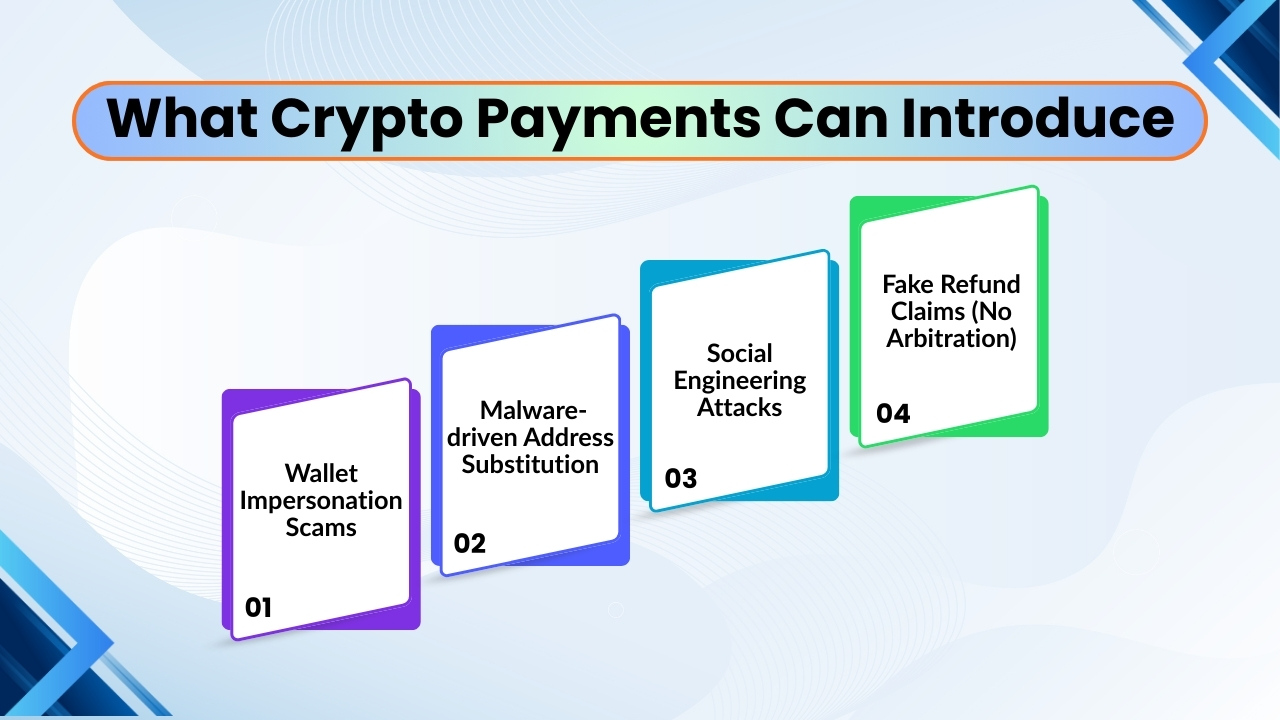
1. Wallet impersonation scams
Fraudsters use lookalike wallet addresses or fake account pages which often depend on small address changes that are easy to miss, sending funds to the wrong wallet instantly.
Also Read: Online Transaction Security Payment Processing in Ecommerce
2. Malware-driven address substitution
Using QR-code payments, keeping devices updated, and avoiding copy-paste from unknown sources further lowers the chance of address-swap attacks.
Also Read: How AI is Changing Fraud Prevention in CBD Transactions
3. Social engineering attacks
Scammers trick customers through DMs, fake support, urgency tactics messages so merchants should publish official support links and warn customers not to trust unsolicited payment instructions.
Also Read: How to Market CBD Business In Social Media
4. Fake refund claims (no arbitration)
Since there is no built-in network dispute process, merchants have to verify refund requests themselves using transaction IDs and blockchain records.
Why it’s higher impact
- Limited recovery: If crypto payment is sent to the wrong wallet whether due to a scam, malware, or a simple typo error, there is usually no reversal process. That can create permanent customer losses, intense support pressure, and reputational damage for the merchant.
- Merchant-owned prevention: Crypto payments put risk management on the merchant. You must secure wallets, confirm addresses, monitor incoming transfers, and communicate payment steps early. As payment reversals are rare, strong verification and support processes are needed to prevent fraud, errors, and customer frustration.
Also Read: How Zero Fees Processing Works for CBD Business
Compliance Still Matters—Even With Crypto
There is a widespread belief that accepting crypto allows merchants to ignore many of the compliance rules that apply to traditional card payments. For CBD businesses, this assumption is especially risky.
Crypto does not remove regulatory responsibility as it simply shifts where that responsibility remains. While card networks and acquiring banks enforce many rules on behalf of merchants, crypto places more of that burden directly on the business itself.
CBD merchants must still comply with product legality requirements, including THC thresholds, labeling standards, and category restrictions that differ by jurisdiction.
Merchants still need location controls to block sales where CBD products are restricted or illegal. Selling into restricted states or countries is still a violation, regardless of whether payment is made by card, bank transfer, or crypto.
Additionally, AML and sanctions obligations do not disappear. Regulators increasingly expect businesses to take reasonable steps to avoid any illicit activity, even when transactions occur on blockchain rails.
Consumer protection expectations also remain. Consumers still expect transparency, fair refunds, and clear communication especially in categories like CBD where trust plays an important role in purchase decisions.
Using crypto payments does not excuse poor disclosure or unclear policies, and regulators are paying closer attention to how alternative payment methods are used.
As a result, banks, regulators, and platforms now expect crypto-accepting merchants to apply controls similar to those used in traditional payments.
This includes monitoring transactions for unusual behavior, verifying customers where appropriate, applying basic risk scoring, and maintaining clear refund and dispute policies. These safeguards help demonstrate that crypto is being used responsibly rather than as a way to avoid oversight.
Avoiding these expectations does not eliminate risk rather it amplifies it. Without shared enforcement from card networks or banks, any compliance failure lands on the merchant.
For CBD businesses already operating under higher scrutiny, crypto works best when it is implemented into a compliance-first payment strategy, not treated as a loophole around existing rules.
Also Read: How Cash Discounting Can Boost Profit Margin for CBD Shops
Volatility: A Hidden Operational Risk
Cryptocurrency volatility is often discussed in terms of investment risk, but for CBD merchants it creates a very operational challenge. Unlike card or bank payments, where the value of a transaction is stable from authorization to settlement, crypto prices can fluctuate sharply in a matter of hours.
A payment accepted at checkout today may be worth noticeably more or less by the time funds are converted, recorded, or refunded. For merchants operating on tight margins, that uncertainty can directly impact profitability.
Pricing consistency is one of the first areas affected. CBD products are usually priced carefully to account for processing costs, fulfillment, and compliance overhead.
When crypto values change, the actual revenue received may no longer align with the listed price, forcing merchants to absorb losses or explain unexpected differences to customers. This becomes even more challenging when promotions, subscriptions, or recurring billing are involved.
Refund accuracy is another major concern. If a customer requests a refund days or weeks after purchase, the crypto amount originally paid may not match its current fiat value.
Merchants then face difficult choices to refund the original crypto amount, refund the fiat equivalent at today’s rate, or issue refunds through another payment method. Each option has customer experience and accounting implications.
Accounting, reconciliation, and tax reporting also become more complex. Price volatility creates discrepancies between transaction-time value and end-of-period valuations, requiring careful monitoring of exchange rates, timestamps, and conversion records. For CBD businesses already navigating complex compliance environments, adding crypto volatility can increase administrative burden.
To manage these risks, many merchants depend on crypto payment processors that automatically convert payments into fiat currency at the point of sale.
This approach stabilizes revenue and simplifies accounting, but it also reintroduces intermediaries. These providers still enforce their own underwriting, KYC checks, transaction monitoring, and settlement controls often reflecting the same safeguards used by traditional processors.
At that stage, crypto payments worked less as a replacement for card payments and more as an alternative payment rail layered on top of the existing financial system.
While crypto payments can still provide flexibility and expand customer choice, it no longer removes compliance, oversight, or dependency on third parties.
For CBD merchants, understanding this trade-off is essential because it shapes both payment reliability and long-term compliance risk. Crypto can offer advantages, but volatility means it must be integrated thoughtfully, with clear operational controls and realistic expectations.
Also Read: Why CBD Business are Considered High-Risk
Customer Experience Considerations
Customer experience is one of the biggest deciding factors in whether adding crypto payments helps CBD sales or quietly reduces conversions through extra checkout friction.
Even though awareness around cryptocurrency is increasing, accepting crypto payments among everyday shoppers is still less. Because some CBD buyers are comfortable with wallets and on-chain payments, and most customers still prefer familiar payment methods like cards and digital wallets.
This gap matters because CBD checkout depends on trust and clarity, usually for first-time buyers who may still be unsure about legality, shipping timelines, and product quality.
Crypto payments can have extra steps and uncertainty which may slow buyers down and disrupt the smooth checkout process. So many customers even if they have a wallet ready, setting up crypto payments may feel like a multi-step technical process compared to other payment options.
Even if a customer already has a wallet, simple errors like choosing the wrong network or pasting the wrong address can derail the payment and create time-consuming support requests.
Changing network fees and slow confirmations can make checkout feel uncertain, especially when customers don’t see an instant “payment received” update.
Most importantly, crypto payments do not offer a familiar chargeback and dispute protections which customers usually expect with card transactions.
Traditional payment options provide familiar protections such as chargebacks and clear refund processes. Because crypto payments can seem irreversible and disputes less straightforward, some buyers may feel less protected when CBD brands are trying to build loyalty and repeat purchases.
Because of these realities, crypto tends to work best as an optional payment method rather than the default. Offering it as a secondary choice can serve crypto-savvy shoppers without forcing unfamiliar complexity on everyone else.
The approach allows merchants to gauge demand without risking conversions, while keeping the main checkout flow quick, familiar, and confidence-building that protects conversion rates, and keep the primary checkout experience simple, fast, and trusted.
Also Read: CBD Advertising Best Practices
Where Crypto Can Make Sense for CBD
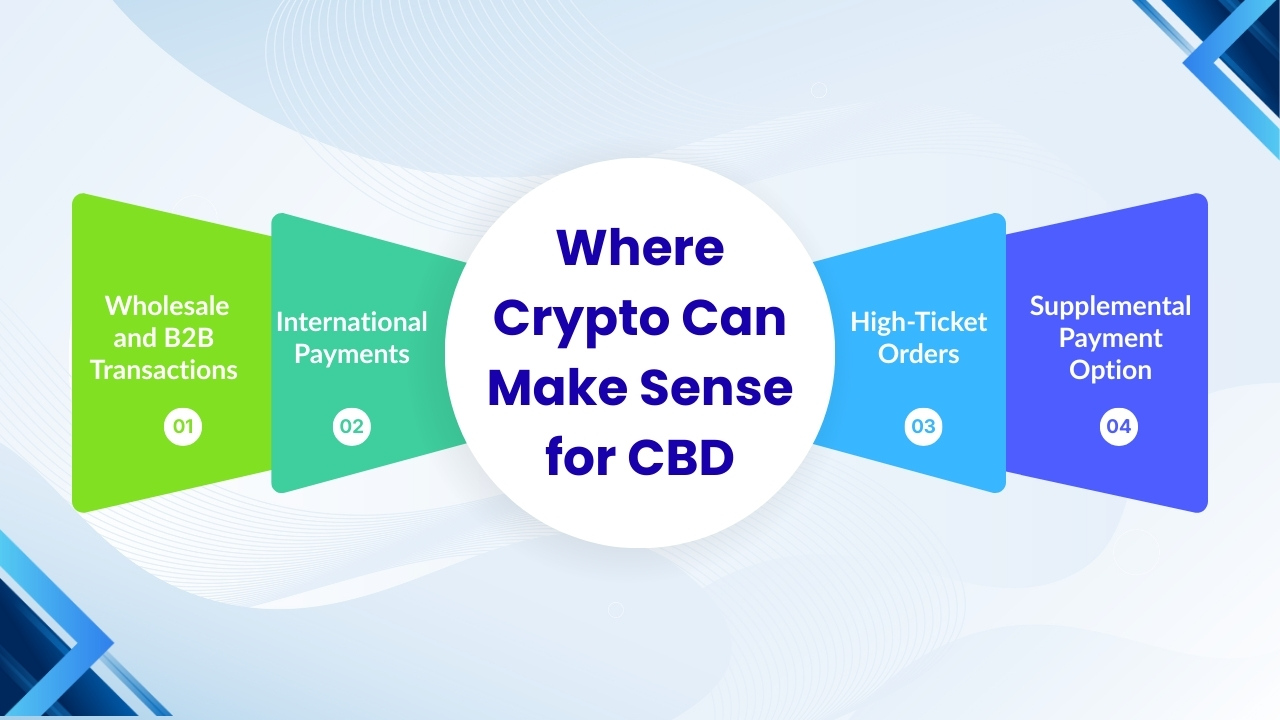
Despite the risks and limitations, crypto can still be useful for CBD merchants if applied selectively and with clear intent. Instead of positioning it as a replacement for traditional payments, it as a replacement for traditional payments, it works best in certain scenarios where its strengths outweigh the friction.
1. Wholesale and B2B Transactions
Crypto payments can be well suited for wholesale or B2B payments where both parties are known and the relationship is ongoing. These transactions usually involve larger amounts, pre-negotiated terms, and fewer disputes.
In such cases, crypto payments may offer faster settlement than traditional wire transfers and may reduce transaction costs depending on the network and payment setup.
Also Read: How Fast Payments Can Improve your CBD Business Cashflow
2. International Payments
In markets where card acceptance is limited or cross-border processing is expensive, crypto payments can provide an alternative way to accept payments.
It helps CBD merchants reach international customers without depending on multiple intermediaries, currency conversions, or region-specific card restrictions. This can be helpful in places where banking access is inconsistent or slow.
Also Read: CBD Terms of Payment
3. High-Ticket Orders
Large CBD purchases are more likely to face card network limitations, fraud flags, or issuer declines. Crypto payments can help approved buyers complete high-value transactions without repeated payment failures.
When used thoughtfully, crypto can remove card limits and unnecessary declines, helping legitimate high-intent customers making important purchases.
Also Read: Is CBD Legal in all 50 States
4. Supplemental Payment Option
Crypto payments work best when offered alongside cards and ACH rather than as the primary checkout method. This gives crypto-savvy customers an alternative without forcing unfamiliar complexity on the broader audience. Choice preserves conversion while still supporting niche demand.
In all of these scenarios, success depends on strong internal controls, clear refund and settlement policies, and transparent communication so customers know exactly what to expect.
Also Read: CBD Payment Compliance
The Role of AI in Crypto Risk Management
When CBD merchants accept crypto, risk controls must shift earlier in the payment flow because most crypto transactions are irreversible.
Without familiar chargebacks or card dispute processes, prevention becomes more crucial than recovery. AI helps merchants manage this risk by evaluating context in real time, reducing fraud exposure without blocking legitimate customers.
AI-driven monitoring can detect unusual wallet behavior that may indicate abuse, such as newly funded wallets, rapid wallet switching, or patterns consistent scripted activity.
It can also identify transaction anomalies by comparing order size, product mix, purchase timing, and cadence against expected behavior for similar customers. This adaptive approach outperforms static rules, which often either catches more advanced abuse while avoiding the false declines that rigid, rule-based systems often create.
Timing and velocity checks are especially useful in crypto payments. AI can flag suspicious bursts or purchases, repeated high-value orders, or behavior that looks automated rather than human. It also supports monitoring for refund-policy abuse, including repeat refund requests or cancellations after confirmation.
Ultimately, AI strengthens compliance by enforcing geo and product-based restrictions, helping prevent restricted CBD items from being sold into restricted regions.
Crypto vs. ACH and Pay-by-Bank
For many CBD merchants, ACH and pay-by-bank payments offer a more practical intermediary ground between traditional cards and crypto payments.
While crypto can reduce fees, ACH delivers many of the same cost benefits without introducing the same level of operational uncertainty or customer friction.
Unlike crypto, ACH payments support structured refunds and returns, which helps merchants resolve issues without any manual intervention or customer frustration.
This built-in reversibility aligns more closely with consumer expectations and reduces the risk of disputes escalating into reputational damage. Banks also provide ongoing oversight, including monitoring, alerts, and feedback when risk levels change, giving merchants clearer signals before problems become serious.
ACH operates within well-defined compliance frameworks such as Nacha rules, making requirements more predictable and easier to manage with time.
For CBD businesses that already face higher scrutiny, this clarity matters. It allows merchants to demonstrate responsible risk management without depending on custom controls or ad-hoc policies.
Consumer trust is another major advantage. Customers are far more familiar with bank-based payments than crypto payments, especially for refunds and billing questions.
While crypto payments may lower costs in some cases, ACH often achieves similar savings while maintaining stability, transparency, and far less operational risk for CBD merchants.
Conclusion
CBD and crypto payments are at an important crossroads of opportunity and risk. On one hand, crypto payments offer clear advantages in specific use cases like cross-border transactions, high-ticket orders, and B2B settlements where speed and flexibility matter.
For merchants facing card network limits or international acceptance challenges, crypto can give opportunities which sometimes traditional payment rails may close.
Contrary, crypto introduces meaningful trade-offs that CBD businesses cannot ignore. Limited consumer adoption, checkout friction, price volatility, and the absence of built-in dispute mechanisms all raise operational and customer experience risks.
Because cbd purchases depend heavily on trust and compliance, a poorly planned crypto option can add enough uncertainty and friction to reduce conversions without merchants noticing right away.
The most sustainable approach is not choosing crypto over traditional payments, but using crypto payments along with traditional payments.
When offered as an optional method supported by strong compliance controls, clear communication, and AI-driven risk management, crypto can serve niche demand without compromising the broader checkout experience.
Ultimately, crypto is not inherently good or bad for CBD as it becomes valuable only when it is applied in the right scenarios, with clear intent and strong controls.
Merchants that balance innovation with compliance and customer trust will be better positioned to convert crypto from a risk into a measured, strategic opportunity.
If you still have any query with the opportunity and risks involved in CBD & Crypto Payments, you may write to us at CBD Merchant Solutions and we are more than happy to assist you.