
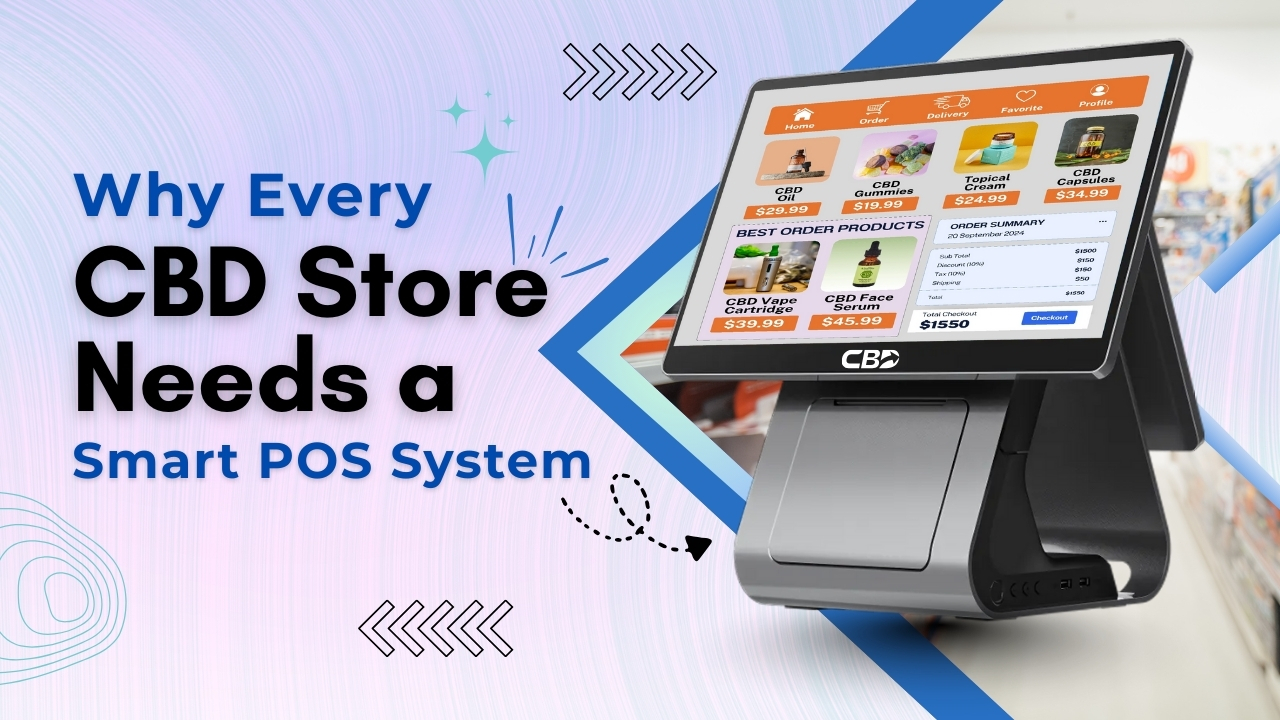
A CBD POS system is not just a cash register rather it is the operating system for a regulated business. In CBD retail, you juggle evolving rules, product education, and skeptical banks, so a smart POS system becomes a compliance engine, inventory brain, and customer-experience hub in one.
The right platform helps you clear underwriting with a CBD-friendly payment processor or high-risk merchant account, keeps PCI compliance right, and reduces chargebacks by combining it with clear receipts with AVS or CVV and 3-D Secure where it makes sense. It also makes day-to-day operations effortless and smooth so your team spends less time struggling and time serving customers.
What sets a modern CBD POS apart is built-in compliance and accuracy. You can enforce age verification at checkout, attach COAs to products, track batch or lot and expiry dates, and apply SKU-level restrictions connected to state-by-state shipping rules or local ordinances.
Omnichannel inventory syncing across in-store, online, and pickup or curbside channels prevents double-selling and out-of-stock surprises. Subscriptions and a loyalty program drive repeat purchases without depending on risky claims, while a recognizable statement descriptor, instant order confirmations, and shipment tracking strengthen chargeback prevention. Real-time reporting highlights margins, sell-through, and refund reasons, and audit logs make compliance audits straightforward.
CBD retailers require tools that are built for category, regulations and workflows, and not generic tools generic retail workarounds. A CBD-specific POS lowers legal risk, raises approval chances, and increases revenue with faster checkout, accurate inventory, and trust-first customer experiences.
If you want stable payment processing, smoother operations, and data you can actually use, a smart POS system designed for CBD is the most important platform decision that you will ever make.
Also Read: Why Every CBD Business Needs a Customized POS System
The CBD Retail Reality: Why every CBD store needs a smart POS system
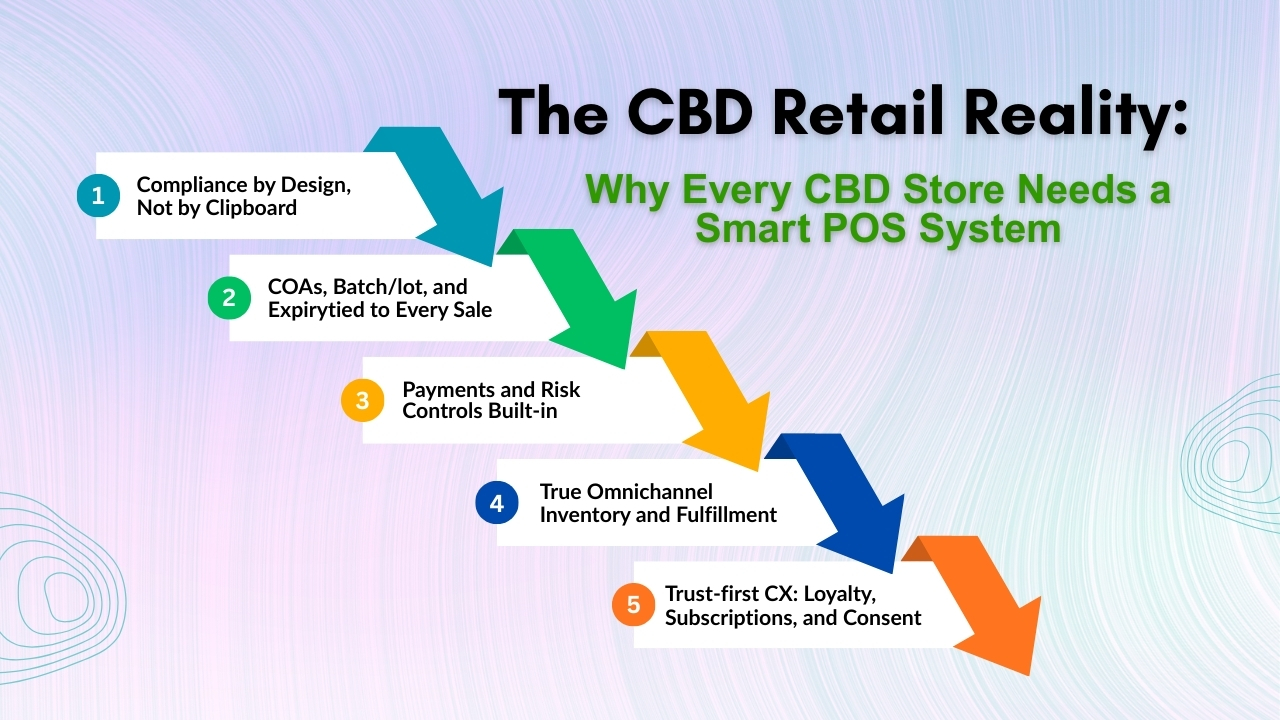
CBD Retail has different rules than other traditional businesses. Below are few reasons why regular POS is not enough for CBD:
1. Compliance by design, not by clipboard
CBD rules shift across states, counties, and even carriers. A generic POS can’t enforce age limits, label requirements, or geo restrictions at the register and online.
Choose a CBD-ready POS with a built-in rules engine that enforces SKU-level age gates, blocks restricted destinations, checks carrier policies, and prompts for dosage or THC disclosures.
It prints policies on receipts, records every override, and maintains auditable trails. When laws change, admins update a central matrix and the system enforces it everywhere like store, eCommerce, BOPIS, and local delivery reducing legal exposure and preventing “human memory” errors at peak hours.
Also Read: How to Create an Effective CBD Business Plan
2. COAs, batch/lot, and expiry—tied to every sale
Underwriting, inspectors, and customers all ask for proof. A smart CBD POS attaches Certificates of Analysis(COAs) to SKUs and specific lots, captures expiry dates on receiving and uses FIFO or FEFO so older stock sells first.
At checkout(in-store and online), it can print or link a COA QR that opens the exact batch. Approaching-expiry alerts, lot quarantine flags, and standardized return reason codes establish a clear, defensible chain of custody. That transparency turns potential disputes into documented resolutions and builds durable consumer trust.
Also Read: How to Start a CBD Dispensary in California
3. Payments and risk controls built-in
CBD is frequently categorized as higher risk. A suitable POS integrates with CBD-friendly processors and embed dispute prevention with recognizable statement descriptors, plain-language receipts, instant confirmations, realistic ETAs, and tracking or proof of delivery.
For online orders, it supports AVS or CVV, optional 3-D Secure on higher-risk baskets, and simple velocity limits to curb fraud. Card-present hardware should offer fast EMV or contactless with offline fallback and automatic sync. A single, unified process for settlements and refunds across channels reduces errors, keeps chargebacks under network thresholds, and indicates operational maturity to underwriters.
Also Read: What is High-Risk Merchant Account Why CBD Needs One
4. True omnichannel inventory and fulfillment
Selling in-store, online, curbside, and wholesale requires a single source of truth. A CBD-ready POS syncs inventory in real time, reserves stock for web orders, auto-releases uncollected items, and prevents overselling.
It supports bundles or kits for instance, sampler packs while maintaining accurate component counts. At checkout, destination rules automatically block no-ship SKUs or switch to in-store pickup, while pick/pack tickets, scan-to-verify, and return or exchange flows keep counts accurate. The result is fewer stockouts, fewer canceled orders, and smoother cash flows.
Also Read: How Much Does an Average CBD Store Make
5. Trust-first CX: loyalty, subscriptions, and consent
CBD shoppers look for clarity and consistency. The right POS powers loyalty without draining margins, supports subscriptions for replenishable products and most crucially offers self-service cancellation to prevent angry chargebacks.
It tracks SMS and email consent by channel, delivers clear education on dose, onset, and cannabinoids, and recommends products by state or prior COA preferences. Reporting tracks margins, sell-through, refund reasons, dispute patterns, and cohort retention so you optimize operations with data and not guesses. This trust-led cycle converts one-time or first-time buyers into reliable customers with higher-lifetime-value customers.
Bottom line: A generic POS system can’t handle CBD’s compliance, documentation, risk, and omnichannel demands. A CBD-aware POS embeds these controls into daily workflows reducing legal risk, improving approval rates, and unlocking scalable growth.
Also Read: How to Get a Merchant Account for Your CBD Business
What Is a “Smart POS” for CBD?
A “Smart POS” for CBD is beyond just being just a point-of-sale system; rather it’s a compliance ready, omnichannel, data-driven operating system built specifically for regulated wellness businesses.
CBD retailers face unique challenges that generic POS platforms can’t solve like strict documentation rules, differing state regulations, frequent order complexity, and higher payment risk. A smart POS system bridges these gaps by integrating compliance, customer experience, and financial operations into one seamless workflow.
Below are the six core components that define a Smart CBD POS:
1. Compliance Controls
A smart POS system integrates legal safeguards directly into daily operations. By making age verification mandatory at checkout, SKU rules adjust automatically on the basis of state regulations, and every product can be linked to batch or lot data, expiry dates, and COA documents. These built-in controls protect retailers from fines, shutdowns, and product-level mistakes.
Also Read: How to Get a Merchant Account For Your CBD Business
2. Omnichannel Inventory
It maintains a real-time single source of truth across in-store, ecommerce, curbside, pickup, and local delivery. This eliminates overselling, reduces manual reconciliation, and keeps customers confident that what’s online actually reflects store availability.
Also Read: How Do You Integrate CBD Payment Solution With Ecommerce Platforms
3. Risk & Fraud Tools
Since CBD is high-risk, smart POS systems include AVS or CVV verification, 3-D Secure for online orders, velocity checks, and recognizable statement descriptors. These features reduce fraud attempts and also reduce dispute frequency.
Also Read: Why CBD Business Are Considered High-Risk
4. Business Intelligence
Real-time dashboards provide insights about margins, sell-through, refund reasons, dispute patterns, and cohort retention, allowing retailers to make data-backed decisions instead of depending on just guesswork.
Also Read: How to Market Your CBD Business on all Social Media
5. Payments Fit
A smart CBD POS integrates with a processor that actually understands the industry providing realistic limits, fair terms, and underwriting that won’t shut you down for selling hemp products. It also offers strong dispute handling and stable approvals, ensuring your business stays compliant and revenue stays uninterrupted.
In short, it functions as a modern retail OS customized to the realities of regulated wellness.
Also Read: How to Choose the Best CBD Payment Processing Company
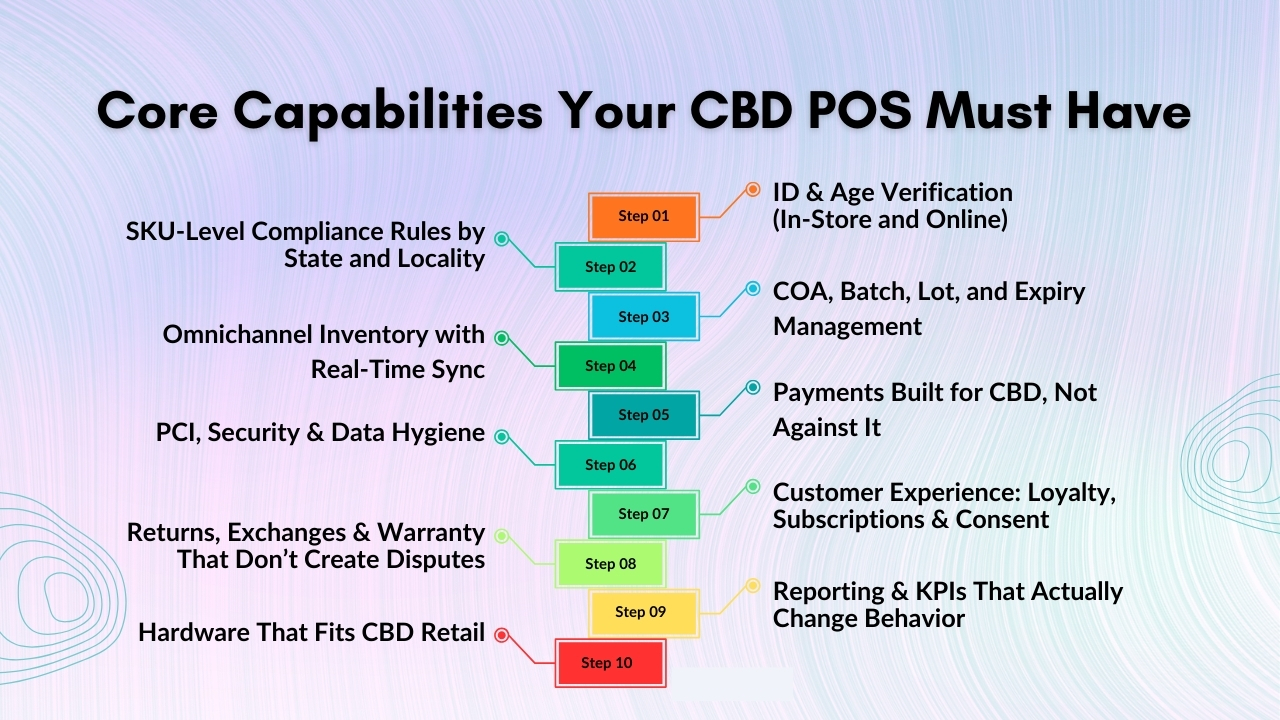
Core Capabilities Your CBD POS Must Have
CBD retail is not like traditional retail. You are navigating a unique mix of regulatory oversight, evolving state-by-state rules, volatile supply chain quality, high-risk payments, strict carrier restrictions, and customers who expect personalized wellness guidance. A generic POS is not built for CBD business and will eventually strain your margins, weaken your compliance standing, and risk damaging your processor relationship.
Rather, CBD retailers need a CBD-aware POS which is a platform designed from the ground level to handle compliance, omnichannel logistics, regulated payments, and the type of personalized experience that builds trust in wellness categories.
Below are 10 essential capabilities your CBD POS must have if you want to grow safely and profitably.
1. ID & Age Verification (In-Store and Online)
Selling CBD responsibly begins quietly before the transaction, it begins with verifying the customer’s age and ensuring the right products go to the right place. A CBD-focused POS needs to handle this without slowing down your operations.
POS Scanning
Modern systems should support scanning driver’s licenses and passports. When a cashier scans an ID, the POS should validate the birthdate instantly and capture only the minimum required information for instance, birth year or age confirmation and not the full PII string. This reduces your compliance risk enormously.
DOB Rules
Different states enforce different age limits like 18+ for topicals in some states, 21+ for ingestibles almost everywhere. Your POS system must enforce SKU-level age restrictions automatically. If a customer does not meet the requirement, the item should be blocked from checkout without any burden on your staff.
E-Commerce Age Gates
For online orders, simple pop-ups are not enough. Your POS or ecommerce integration should require acknowledgement of age at checkout and support third-party verification services for high-risk items like ingestibles. THCA flower, or Delta-8.
Why It Matters
Proper age verification feature protects your CBD business license, your payment processor relationship, and your operational trustworthiness. It also reduces the risk of post-sale disputes related to restricted-item purchases.
Also Read: How to Get a CBD License
2. SKU-Level Compliance Rules by State and Locality
CBD compliance is not universal or uniform; rather it changes based on state, county, municipality, and even carrier policies. A CBD POS must treat compliance as a programmable rules engine, and not a manual guesswork exercise.
Rules Engine
Each SKU should carry attributes:
- Ingestible or topical
- THC% or THCA%
- Presence of Delta-8 or Delta-9
- Nicotine adjacency
- Ship-eligible or no-ship states
- Local restrictions (for instance, some counties ban hemp vapes, even if the state allows them).
Automatic Cart Checks
When a customer adds an item to their cart(in-store or online), the POS should evaluate their location automatically. A compliant engine should:
- Block items that can’t ship to their state
- Suggest alternatives
- Swift fulfillment to in-store pickup for restricted items
- Adjust shipping carriers based on item rules
Carrier Logic
Carriers such as USPS, UPS, and FedEx have their own rules on hemp-derived products. Your POS should automatically block service methods that won’t accept your SKU category.
Transparent UX
Never surprise the customer. A compliant POS should show clear, upfront messages such as, “Sorry, this product can’t ship to your state due to local regulations”, so shoppers understand the limitation, trust your brand more, and are less likely to abandon their cart.
Why It Matters
Automated, accurate compliance dramatically reduces the risk of seizures, returns, fines, and processor scrutiny, keeping your CBD business protected, your inventory flowing smoothly, and your overall customer experience clear, predictable, and frustration-free.
Also Read: Is CBD Legal in all 50 States
3. COA, Batch, Lot, and Expiry Management
In CBD, product quality and transparency are non-negotiable. Consumers care about cannabinoids, terpenes, safety, and consistency are regulators that demand full traceability.
Attach COAs to SKUs and Lots
Your POS should link each COA(such as a PDF or URL) directly to specific SKUs and their lots, so every sale is linked to an exact batch. That way, you always know which product, which lot, and which lab report a customer received.
Scan on Receive
When new inventory arrives, staff should be able to scan UPCs or QR codes to capture:
- Batch numbers
- Lot identifiers
- Expiry dates
- COA versions
This ensures correct association with shelf labels and online product pages.
Sell-Down Preference
Sell-down preference means your POS should prioritize FEFO or FIFO automatically, ensuring products nearing expiry move first. It should also flag aging inventory early, allowing you to act before products expire, reducing waste, staying compliant, and keeping your shelves stocked with fresh and safe items.
Customer Transparency
Customer transparency means every receipt or product label includes a QR code that links directly to the exact COA and batch the shopper purchase, reducing document hunting, mismatches, confusion, and support tickets while reinforcing trust in your products and brand.
Why It Matters
Strong traceability protects your business during inspections, recalls, customer complaints, and supplier disputes by proving exactly what was sold and when. It also sends a powerful trust signal to customers especially in wellness showing that safety, quality, and accountability are not marketing claims but they are built into your operations.
Also Read: The Best Marijuana Marketing Strategies
4. Omnichannel Inventory with Real-Time Sync
CBD shoppers expect flexibility like in-store, online, curbside, delivery, marketplaces. This only works with a true omnichannel inventory engine.
Single Stock Ledger
Your POS should serve as the single source of truth across:
- POS retail
- Shopify, WooCommerce, or headless ecommerce
- Local delivery partners
- Curbside and BOPIS orders
- Marketplaces and social commerce
Hold & Pick Logic
When a customer places a pickup or curbside order, your POS should immediately reserve those units so they can’t be sold twice, then automatically release them back into available inventory if the order expires or the customer never shows up to collect.
Kits & Bundles
CBD shoppers love starter kits and curated bundles, so your POS must handle virtual bundles that pull from underlying SKUs automatically, reducing each component’s inventory accurately at checkout instead of treating bundles as separate products that break inventory accuracy and confuse reporting and reordering.
Reorder Automation
Reorder automation means your POS tracks sell-through and vendor lead times, then suggests POs before you run out keeping key CBD SKUs in stock without overbuying. You protect cash flow, avoid stockouts, and stop depending on guesswork or last-minute emergency orders.
Why It Matters
Real-time inventory stops oversells before they happen, reduces costly refunds, and keeps every sales channel like store, online, delivery, and curbside running smoothly without the confusion and chaos that happens due to outdated or manual stock trading.
Also Read: How to Market Your CBD Business on Facebook
5. Payments Built for CBD, Not Against It
Almost 80% of CBD retailers get into trouble due to payments. High-risk categories require processors that understand CBD and POS systems that understand CBD and POS systems that keep in-store and online payments in sync under one roof.
Processor Alignment
Processor alignment means your POS connects to a CBD-approved processor and not a generic aggregator that can shut you down overnight with underwriting that clearly defines allowed categories, limits and terms so there are no surprises as your business grows and scales.
Dispute Prevention
Your POS should generate:
- Clear, consistent receipt descriptors
- Order confirmations with item details
- Tracking links
- A customer support contact
These simple steps drastically reduce disputes.
Fallback Modes
Fallback modes ensure your POS keeps running even when the internet does not. A high-quality terminal should process EMV and contactless payments offline, store them securely, and automatically sync and authorize once when the connection returns, preventing lost sales, long lines, and frustrated customers during unexpected outages.
Unified Settlement View
Your POS should unify in-store and online transactions into a single settlement dashboard, making reconciliation, refunds, and voids far simpler while giving finance and operations one clear view of cash flow, fees, and processor performance.
Why It Matters
CBD payments operate in a high-risk lane, so stability, transparency, and processor alignment are crucial, which is why a structured setup drastically reduces surprise account freezes, held deposits, and costly chargebacks that can negatively impact your cash flow and growth.
Also Read: How to Protect Your CBD Business From Payment Processor Shutdowns
6. PCI, Security & Data Hygiene
CBD retail operates in a high-risk environment making security a basic requirement rather than a nice-to-have. Your POS must be built around strong PCI practices, strict data controls, and airtight permissions to protect customers, satisfy auditors, and maintain processor trust.
Tokenization & P2PE
Tokenization and P2PE ensure card-present transactions remain fully protected from the moment a customer taps or inserts their card. Data is encrypted end-to-end and instantly tokenized which means that raw card details never touch your POS system considerably reducing breach exposure, PCI scope, and overall security risk.
3-D Secure
3-D Secure adds an extra verification to online orders, confirming the shopper’s identity before the transaction completes. This reduces fraud, reduces unauthorized chargebacks and strengthens your overall payment security especially important in high-risk categories such as CBD.
Role-Based Controls
Your POS must include:
- Cash drawer permissions
- Manager override PINs
- Blind tills
- User activity logs
- No shared accounts
Least-Data Storage
Least-data storage means your POS keeps only the minimum information required to operate particularly when handling customer details, ID checks, and COA files so you limit exposure, reduce compliance risk, and reduce the impact of any potential security incident.
Audit Trails
Audit trails mean every discount, return, and void generates an uneditable log linked to users, timestamps, and reasons. This strengthens internal controls, deters misuse, and gives auditors and underwriters clear visibility regarding how transactions are handled inside your store.
Why It Matters
In regulated spaces like CBD, even a small security breach can lead to fines, lawsuits, reputational damage, or losing your processor. A secure POS protects both your customers’ data and your business’s ability to operate.
Also Read: How Fast Payments Can Improve Your CBD Business CashFlow
7. Customer Experience: Loyalty, Subscriptions & Consent
CBD is fundamentally a wellness business, where trust and consistency matter and most revenue comes from repeat buyers rather than one-time shoppers. Your POS must nurture that cycle with tools for loyalty, subscriptions, personalization, and compliant consent capture so customers return predictably and confidently.
Loyalty
Loyalty programs should improve retention while protecting margins, using points,tiers, or punch-style rewards to build habits without endless discounts. Shape rewards around visit frequency, basket size, and preferred categories so customers feel recognized and rewarded while your profit per visit stays healthy, sustainable, and growing over time, and not just once.
Subscriptions
Recurring orders for gummies, tinctures, and softgels are common and are profitable. A CBD POS should support flexible intervals, item swaps, and especially self-serve cancellation, which reduces chargebacks and frustration.
Consent-Aware Marketing
Consent-aware marketing means every SMS or email opt-in is TCPA-compliant and connected to a customer profile with timestamps, age verification, and preference data, ensuring messages are both legally safe and genuinely relevant.
Personalization
Your POS should recommend products based on:
• Need state (sleep, recovery, calm, focus)
• Preferred form factor
• Cannabinoid profiles
• COA preferences from past purchases
Why It Matters
Repeat CBD customers cost far less to retain than acquiring new ones, and they generate more predictable, higher-lifetime value revenue. Building loyalty and subscription habits is essential for sustainable growth in a wellness-driven, trust-based category such as CBD retail.
Also Read: How to Market Your CBD Business on Facebook
8. Returns, Exchanges & Warranty That Don’t Create Disputes
Returns, exchanges, and warranties must be managed in a way that protects revenue and prevents disputes. A smart POS provides clear policies, reason codes, photo evidence capture, and easy store-credit options which turn possible chargebacks into smooth, controlled resolutions that keep customers satisfied and your processor relationship stable.
Clear Policy on Receipts
Your POS should automatically print your return policy on every receipt and include it in order confirmation emails, eliminating confusion later and giving customers clear expectations that help prevent disputes or surprise chargebacks.
Reason Codes
Reason codes let cashiers tag each return by cause like taste, effect, packaging damage, leakage, or shipping issues so you can identify patterns, improve QA, and use real data in supplier negotiations instead of guessing why products are coming back.
Instant Store Credit
Instant store credit turns a negative moment into a save. Rather than issuing cash refunds, your POS should make it simple to offer credit, which keeps revenue in-house, encourages future purchases, and usually preserves the customer relationship instead of ending it.
Photo Evidence Capture
Photo evidence capture means that when damaged goods come back, staff can quickly snap images via tablet or scanner right inside the POS, creating timestamped proof for vendors, carriers, or insurers and speeding up credits, replacements, and claim approvals.
Why It Matters
A smart returns workflow transforms moments that typically cause chargebacks into smooth, documented, and professional resolutions, preserving revenue, protecting your processor relationship, and leaving customers treated fairly rather than frustrated or forced to dispute the transaction.
Also Read: Guide to Start a CBD Business
9. Reporting & KPIs That Actually Change Behavior
A CBD POS must clearly reveal what is actually driving your results highlighting both the strengths improving performance and the issues quietly dragging it down. Because regulated wellness retail has tight margins, fast-moving inventory, and strict compliance rules, you can depend on gut instinct alone. You need clear, actionable visibility into sales patterns, product velocity, customer behavior, refunds, and dispute trends. When your POS highlights what is working and what is quietly failing you can intervene early, optimize confidently, and run the business with precision rather than any guesswork.
Your system should provide dashboards and exports for:
• Sales by SKU, brand, category, and COA batch
• Sell-through velocity, weeks of supply, and aging inventory
• Gross margin and discount leakage
• Shrink/spoilage and near-expiry alerts
• Refunds, dispute pipeline, alerts
• Cohort retention (repeat rate at 30 or 60 or 90 days)
• Staff performance, attach-rate, UPT, and conversion
Why It Matters:
Good reporting catches issues early like a batch that tastes different or a flavor variant that is dying on shelves. Data eliminates guesswork and helps you optimize cash flow, product assortment, staffing, and promotions with confidence.
10. Hardware That Fits CBD Retail
Your POS hardware should accelerate CBD retail workflows and not slow them down. Fast EMV or contactless terminals, 2D barcode scanners for COA and batch lookup, reliable printers, secure cash drawers, and optional kiosks or tablets all help reduce errors, shorten lines, and create a smoother, more educational customer experience.
EMV/Contactless Terminals
Fast EMV and contactless terminals ensure transactions happen quickly and smoothly, crucial for wellness shoppers who expect modern, effortless checkout. Faster chip reads reduce wait times, prevent bottlenecks, and create a polished, trustworthy in-store experience.
2D Barcode Scanners
2D barcode scanners are essential in CBD retail because COA QR codes, batch identifiers, and detailed product labels need advanced scanning capability. With a 2D scanner, staff can instantly access lot data, lab reports, and product details without errors or slow manual lookups.
Cash Drawer & Receipt Printer
Your cash drawer and receipt printer should be fully integrated with the POS, role-restricted, and tracked ensuring only authorized staff can access them and every opening, receipt, or adjustment is recorded for security and accountability.
Optional Kiosk or Tablet
Optional kiosks or tablets allow customers to explore products through guided discovery, need-state quizzes, and age-gated education. They reduce staff load, improve engagement, and help shoppers find the right CBD products confidently and compliantly.
Why It Matters
Even small hardware upgrades like faster scanners, smarter terminals, reliable printers reduce cashier errors, shorten wait times, and deliver a smoother, more polished customer experience that reflects the professionalism and quality of your CBD brand.
Conclusion
A Smart POS system is not just a technical upgrade for CBD retailers; rather it is the infrastructure that supports compliant growth, customer trust, and long-term profitability.
In a category where regulations shift constantly, products require batch-level traceability, and payment processors scrutinize every detail, depending on a generic POS leaves your business exposed.
A CBD-aware system replaces guesswork with automation, enforcing age checks, SKU restrictions, COA tracking, and carrier rules without slowing down your team. It unifies in-store and online operations, syncs inventory in real time, and gives customers a consistent, transparent experience from browsing to checkout to returns.
Most importantly, a Smart POS strengthens revenue while lowering risk. It reduces blocked carts, improves conversion, reduces churn through subscription control, and prevents disputes with clean documentation and recognizable descriptors.
Add in loyalty tools, consent-aware marketing, and meaningful reporting, and your store shifts from reacting to problems to running on a clear, proactive strategy.
In a wellness-driven, trust-heavy market like CBD, your POS is not just a register; rather it’s a compliance engine, a growth system, and a customer relationship platform. A Smart POS is how CBD retailers scale safely, confidently, and profitably.
If you still have any query regarding why CBD needs a Smart POS system feel free to write to us at CBD Merchant solutions and we are more than happy to assist you.
Frequently Asked Questions (FAQs)
1. Can a Smart POS really reduce chargebacks?
Yes. With recognizable receipt descriptors,tracking links, proper documentation, and self-serve subscription controls, dispute rates reduce significantly.
2. How does a Smart POS help with COA and batch tracking?
It attaches COAs to each SKU and lot, tracks batch numbers at sale time, and produces QR-coded receipts which is essential for audits, customer questions, and safety assurance.