
CBD is no longer a niche wellness product instead it’s a fast-growing industry with customers who expect the smooth checkout experience that they get everywhere else.
But for many brands, CBD payment processing is not a seamless process yet due to higher fees, sudden account holds, limited options, and stricter compliance requirements.
That is exactly why the focus is moving toward the future of CBD payments where innovation, regulation clarity, and consumer behavior are establishing a new standard for how CBD businesses accept money.
In the next few years, contactless payments, mobile payments, and wallet-based checkout will become the default payment option for CBD retail and eCommerce.
Shoppers are already preferring tapping cards and phones using NFC-enabled terminals, Apple Pay, Google Pay, and other digital wallets because it is faster, safer and more convenient.
For CBD merchants, these payment options don’t just improve speed; rather they can reduce fraud exposure through tokenization, strengthen customer trust at checkout, and increase conversion rates online and in-store.
At the same time, the CBD industry is moving beyond traditional cards. More CBD brands are adopting ACH payments, bank transfers, and other alternative payment methods to lower processing costs and reduce chargeback risk.
On the compliance front, modern providers are building CBD merchant account solutions designed for long-term stability, with better monitoring, clearer underwriting, and support compliant product catalogs.
Through this blog we will walk you through the future of CBD payments like omnichannel checkout, smarter gateways, compliance-first payment infrastructure, and the tools which will define the next generation of CBD payments.
Also Read: How to Choose the Best CBD Payment Processing Company
Understanding the Unique Challenges of CBD Payments
CBD payments are challenging due to constant changing rules and cautious banking policies which causes many processors to classify the industry as high-risk.
Even when hemp-derived CBD products meet legal limits, still many banks and processors still label CBD as high-risk and implement stricter monitoring, and increased card-network scrutiny.
As a result, merchants may face higher processing fees, fewer payment options, slower payouts, and unexpected account holds or account shutdowns.
CBD merchants also require to remain strictly compliant through accurate product labeling, clear marketing claims, and proper documentation while still maintaining checkout fast and smooth both online and in-store.
1. Regulatory Complexity
As CBD is governed by federal, state, and sometimes local regulations, compliance becomes more complicated for both merchants and the banks or payment processors which they depend on.
Even hemp-derived products that meet legal THC limits can still be considered as a high-risk category by banks and processors because rules are different by region and continue to evolve.
Due to this uncertainty, processors remain cautious during onboarding and track accounts more closely afterward, so CBD is classified as high-risk, which means stricter approvals, more paperwork, higher costs, and closer review of product and marketing claims.
Due to this uncertainty, processors tend to be cautious during onboarding and monitor accounts more closely afterward, so CBD is often labeled as high-risk, which means stricter approvals, more paperwork, higher costs, and closer review of product and marketing claims.
Also Read: How to Get a CBD License
2. Banking Hesitation
Traditional banks and many payment processors take a cautious approach due to which CBD is often classified as a higher-risk category due to regulatory complexity and reputational concerns.
To reduce compliance risk, some providers either completely avoid CBD merchants completely while other payment providers accept CBD merchants with strict controls and regular checks, and ongoing account reviews.
For CBD businesses, that caution causes higher processing fees, rolling reserves, and stricter underwriting which impact margins and cash flow.
Whenever the risk policy of the provider changes, merchants may experience sudden account closures or slower settlements, and they may be restricted from using modern payment options like contactless terminals, mobile wallets, and advanced fraud prevention making checkout less smooth for customers.
Also Read: Which Bank Supports CBD Business
3. Consumer Expectations
Even when payment rules are complex, customers still want CBD checkout to be effortless and familiar as buying groceries, clothing, or daily essentials.
Customers expect a fast and familiar payment experience like tap-to-pay in store, smooth mobile checkout online, and instant digital receipts because any delays or failed payments can instantly create doubt and reduce trust, usually for first-time buyers.
CBD must offer a checkout that feels fast and effortless to customers, while still meeting the strict compliance, underwriting, and risk requirements processors demand.
Innovation is helping close this gap by introducing smarter, compliant payment options that still keep checkout fast, smooth buying experience for customers.
Smarter payment technology is allowing businesses to maintain compliance while offering the fast and smooth checkout experience that customers expect.
Also Read: Customer Loyalty Programs In CBD Retail
The Rise of Contactless Payments in CBD Retail
Contactless payments are quickly becoming the standard in CBD and not an additional feature. Customers now look for a simple tap on a card or phone for a fast and smooth checkout experience.
Tap-to-pay reduces wait time, keeps checkout simple, and makes the purchase feel familiar and trustworthy especially for new CBD buyers.
For merchants, contactless checkout helps move more customers through during rush periods. As NFC-enabled terminals and mobile wallets become common everywhere, CBD retailers that don’t offer contactless risk are failing behind.
Also Read: Secure Payment Processing for CBD Ecommerce
Why Contactless Matters
Contactless payment matters more than ever because tap-to-pay has become the new default payment option, and businesses that don’t support it quickly feel outdated.
More shoppers now choose to tap a card or phone rather than swiping or inserting because it’s faster, more hygienic, and more convenient.
This shift towards contactless payments increased after the pandemic as low-touch became a priority, and it’s kept rising since because tap is simply more convenient everyday.
Tap-to-pay takes just seconds and keeps checkout flowing in busy stores; for CBD merchants, it reflects the effortless experience customers get everywhere else, making buyers feel more at ease and confident at the counter.
Also Read: How to Set-up Online CBD Payments in Less than 24 Hours
NFC-Enabled Terminals
Modern EMV terminals with NFC(Near Field Communication) let CBD merchants accept the payment types customers use most today like tap-to-pay cards, mobile wallets, and even smartwatches.
This modern setup speeds up checkout, reduces counter mistakes, and delivers a smoother customer experience especially during busy hours.
Just as important, NFC-enabled terminals deliver stronger security than older swipe systems by using EMV chip standards, encryption, and tokenization to replace sensitive card data with secure transaction tokens.
That added protection can really help by reducing fraud and chargebacks and giving CBD merchants operating in a category that banks and processors tend to watch closely.
Also Read: Understanding CBD Payment Terms
Impact on In-Store CBD Sales
Contactless payments can have an impact on in-store CBD sales by shaping how customers feel at checkout. A faster, tap-to-pay experience reduces customer hesitation which is especially important for first-time CBD buyers who may already feel unsure about the product or the purchase.
When checkout feels as familiar and effortless as it does at a major retailer as it removes friction and hesitation building trust, improving conversion, and making shoppers more likely to complete the purchase and come back again.
Also Read: How Much Does an Average CBD Store Make
Mobile Wallets and the CBD Consumer
Digital wallets are changing the way people buy CBD products by making checkout faster, easier, and safer as now most customers expect to use
Apple Pay, Google Pay, or similar options online and in-store since there is no need to type card details or even carry a physical wallet.
For CBD brands, supporting mobile wallets removes checkout friction which improves conversions and helps reduce cart abandonment usually for shoppers on smartphones.
Mobile wallets add more protection through tokenization, helping reduce fraud, and since many CBD purchases happen on phones and through subscriptions, wallet payments are becoming a core part of the overall brand experience.
Also Read: CBD Email Marketing Campaign Guide
Growth of Mobile Wallet Adoption
Mobile wallet use has surged with millions of consumers relying on Apple Pay, Google Pay, and similar options daily for everything from transit and meals to shopping and entertainment.
As CBD becomes wider acceptance, customers increasingly expect the same smooth payment convenience for CBD purchases both online and at the counter.
Mobile wallets boost security by keeping the real card number hidden and using a unique token for each purchase, which helps prevent card-data theft and makes transactions safer for customers.
For CBD merchants, accepting mobile wallets meets today’s expectations while delivering quicker checkout and stronger, built-in security.
Also Read: Ultimate Guide to CBD Social Media Marketing
Benefits for CBD Merchants
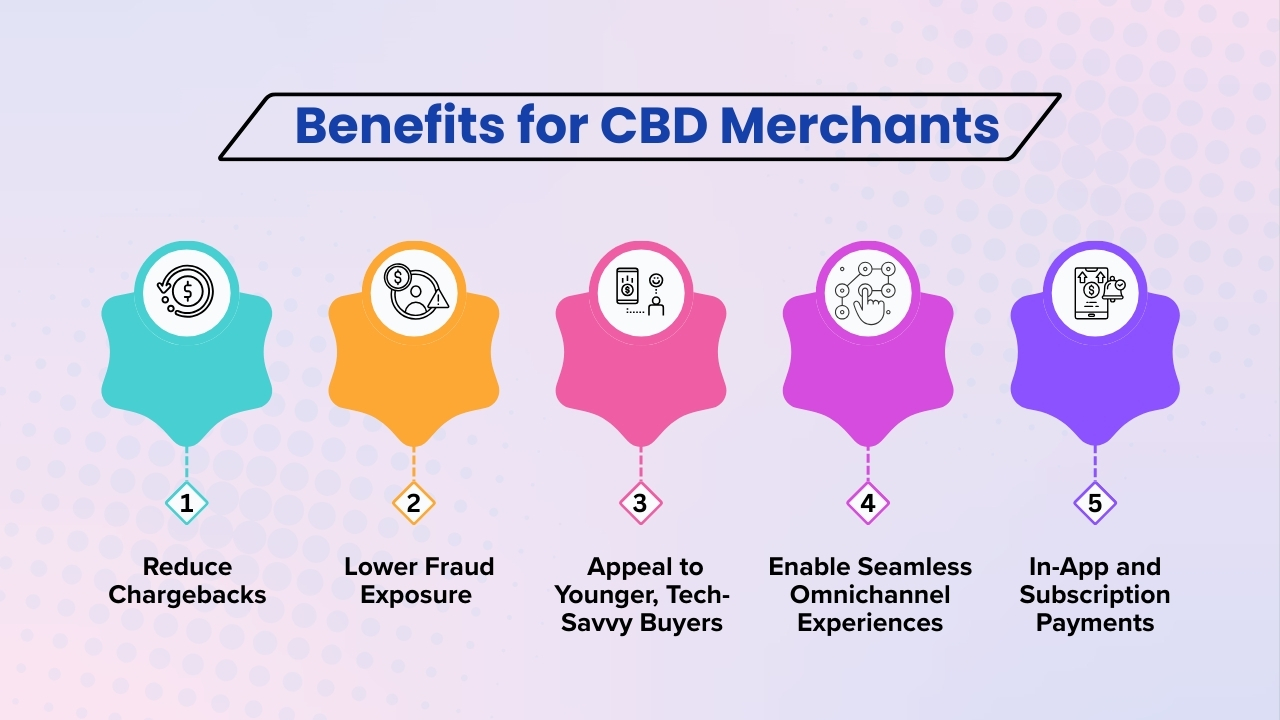
Accepting mobile wallets helps CBD businesses:
1. Reduce Chargebacks
Tokenized mobile payments make it harder for stolen card data to be used, helping prevent unauthorized purchases and lowering disputes and checkouts.
Also Read: Understanding Chargebacks in CBD Industry
2. Lower Fraud Exposure
Tokenization replaces card details with secure tokens, making transactions far harder for fraudsters to misuse.
Also Read: How to Avoid Frauds and Chargebacks in CBD Payment Processing Company
3. Appeal to Younger, Tech-Savvy Buyers
Many people prefer mobile wallets and expect a modern, tap-friendly checkout when buying CBD.
4. Enable Seamless Omnichannel Experiences
Mobile payments flow easily across in-store, online, and app-based purchases, keeping the customer journey consistent and connected.
Mobile wallets can also connect smoothly with loyalty programs, digital receipts, and CRM tools helping brands drive deeper, ongoing customer engagement.
5. In-App and Subscription Payments
As CBD brands grow into mobile apps and subscription plans like monthly tinctures, gummies, capsules, or skincare as mobile payments become essential for keeping checkout effortless, customers engaged, and renewing.
Subscribers want things effortless as one-tap renewals and stored credentials eliminate repeated card entry, reduce failed payments, lower churn, and help customers stay consistent with their wellness routine.
Mobile-friendly checkout makes it easier to add extras, upgrade to bundles, and place quick reorders between subscription deliveries.
For CBD businesses focused on long-term growth, smooth-in app checkout and reliable subscription billing can directly increase customer retention, recurring revenue, and overall customer lifetime value.
Also Read: How Fast Payments Improve your CBD Business Cashflow
eCommerce Evolution: Faster, Safer Online CBD Payments
Online CBD sales are growing fast, and shoppers expect the same fast, smooth checkout they get from top eCommerce brands pushing CBD payment tech towards smarter gateways, stronger security, and truly mobile-first experiences.
Today’s CBD-friendly processors provide smarter tools to reduce fraud, boost approval rates, and reduce chargeback risk without adding more friction for legitimate buyers.
Features like tokenization, hosted checkout, repeat buyers, and real-time risk screening protect both shoppers and merchants, and as the market gets more competitive, fast, secure online payments are becoming an advantage for CBD brands chasing higher conversions, repeat customers, and long-term stability.
1. Smarter Payment Gateways
Modern CBD-friendly payment gateways are becoming more advanced, helping merchants improve approvals without increasing risk. Dynamic fraud filtering continuously evaluates behavior patterns, blocking suspicious activity while allowing real customers moving through checkout smoothly.
Velocity checks spot abnormal transaction patterns like repeated attempts, rapid purchases, or unusual spikes that often indicate fraud. Device fingerprinting adds more security by identifying risky devices, even when attackers switch cards, emails, or accounts.
Many platforms now use real-time compliance checks to stop questionable products or activity before it creates processor issues, reducing false declines that hurt conversions while still protecting CBD merchants against fraud, chargebacks, and unnecessary scrutiny.
Also Read: Comparing CBD Payment Gateway
2. Hosted Checkout and Tokenization
Many CBD businesses are moving towards hosted checkout pages so they don’t have to handle sensitive card data directly on their own servers.
This approach reduces PCI scope because payment information is collected and processed in a secure, compliant environment managed by the payment provider.
Hosted checkout can also improve approval rates by using optimized payment flows and trusted security signals that processors recognize.
It reduces the compliance burden, freeing merchants to focus on growth rather than being stuck in security paperwork and always changing technical rules.
Tokenization strengthens security by replacing card details for protected tokens, so sensitive data stays hidden even with saved cards, subscriptions, and recurring billing.
Also Read: Top 5 Challenges in CBD Payment Processing and How to Overcome It
3. One-Click Checkout Experiences
In online CBD shopping, even small checkout delays can cause cart abandonment, which is why one-click and express checkout options are quickly becoming the standard for CBD eCommerce.
Saved payment methods let repeat customers purchase in seconds, and Apple Pay or Google Pay makes mobile checkout even faster by skipping manual entry, often needing only a quick tap and Face ID, fingerprint, or other biometric confirmation.
Autofilled shipping and billing details make mobile checkout even smoother, and when the experience feels fast and familiar, fewer shoppers abandon their cart often leading to more completed purchases and higher conversion rates.
Also Read: CBD Payment Compliance 101
Alternative Payment Methods: Expanding Beyond Cards
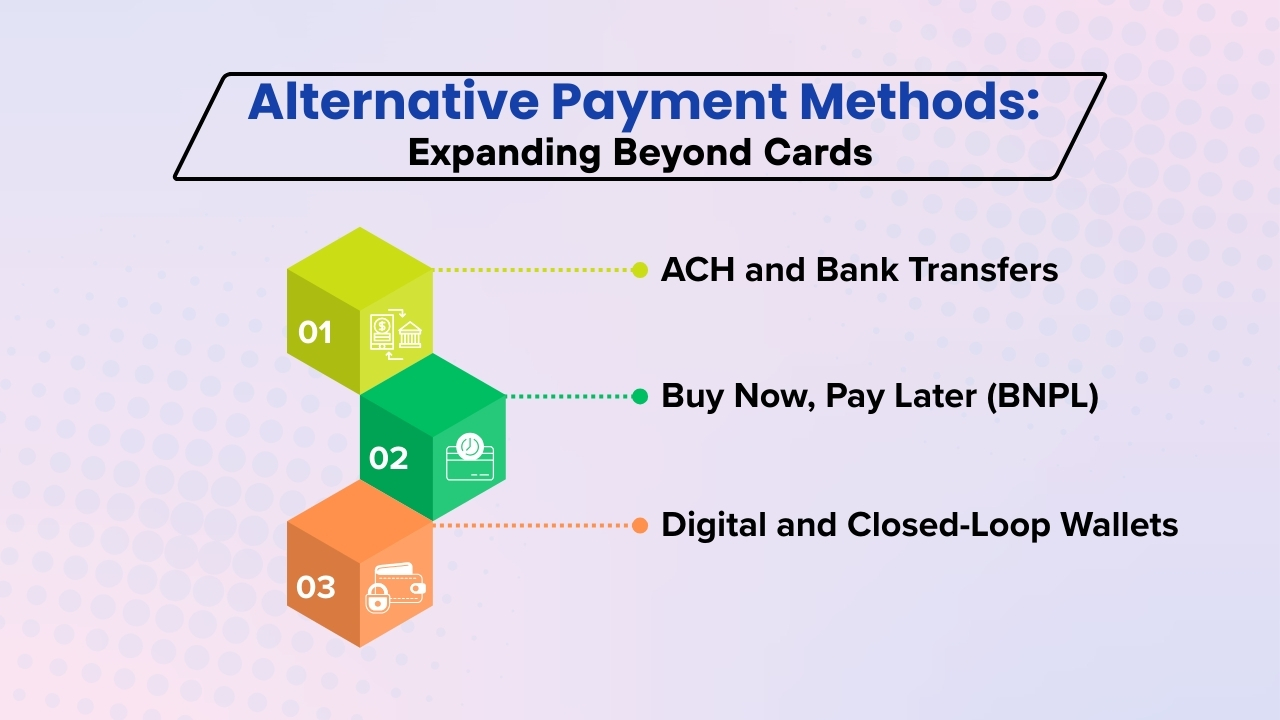
Even though credit and debit cards still drive most CBD sales, more merchants are adding alternative payment methods to reduce costs, improve stability, and lower chargeback risk.
CBD businesses are increasingly offering options like ACH transfers, direct debit, and account-to-account payments to avoid some of the friction that comes with card networks.
These methods are especially helpful for larger orders, wholesale customers, and subscription billing where reliability is crucial, and many merchants are also adding digital wallets, pay-by-bank options, and flexible financing options to improve conversion rates.
As technology improves and customer trust grows, alternative payment methods will play a bigger role in CBD by offering more choice at checkout and reducing dependency on any single payment channel.
1. ACH and Bank Transfers
ACH and bank transfers are becoming common payment options in CBD for wholesale, B2B, and higher value orders as there are no card processing fees which usually add up quickly on large transactions.
As ACH transfers move money directly between bank accounts, they offer lower processing fees and more predictable pricing than card payments.
It also lowers chargeback as disputes are usually less and work under different rules than card chargebacks, which makes it a reliable and cost-effective option for higher-value and recurring CBD payments.
Also Read: Which Bank Supports CBD Business
2. Buy Now, Pay Later (BNPL)
With CBD products expanding into premium bundles, wellness kits, and subscription offers, Buy Now, Pay Later(BNPL) has become a valuable payment option to give customers more payment flexibility at checkout.
BNPL allows customers to split a large purchase into smaller installments, while merchants are usually paid the full amount upfront.
Such flexibility allows customers to afford premium CBD products, even for first-time buyers who want to buy a larger bundle instead of paying the full amount at once.
It can increase average order value as BNPL options encourage customers to add more, less hesitation during checkout, and also attract budget-conscious shoppers who look for predictable installments rather than a single upfront charge.
3. Digital and Closed-Loop Wallets
Some CBD brands are using digital, closed-loop payment options like in-store wallets, store credit, or prepaid balance which allows shoppers to save and use for future purchases.
These systems often lead to repeat purchases by letting customers return, reorder, and pay instantly without re-entering payment details.
By shifting transactions into a wallet or store-credit balance reduces their dependence on card networks, keeps payments stable, and potentially lowers some processing costs.
With time, closed-loop wallets can create a brand where loyalty rewards, referrals, subscriptions, and promos all flow into a single unified balance.
For CBD brands who focus on retention, wallet based models can increase brand loyalty and increase customer lifetime value.
Embedded Finance and the CBD Ecosystem
Embedded finance is rapidly shaping how CBD businesses operate, sell, and grow. It brings financial services into the platforms that merchants already depend on like POS systems, eCommerce stores, CRMs, and online marketplaces removing the need to struggle with multiple third-party providers.
For CBD businesses, this integration offers real advantages. Merchants are able to accept payments smoothly, receive faster on instant payouts, and view all transactions through unified reporting dashboards.
The result is smoother cash flow, reduced operational complications, and better visibility into business performance which are all crucial in a highly regulated industry like CBD.
As CBD marketplaces and multi-vendor platforms keep growing, embedded finance becomes even more essential. These platforms should support split payments, automated vendor settlements, and accurate tax and compliance reporting.
Embedded payment solutions are purposefully built for these challenges, enabling scalable and compliant business growth while improving the experience for both sellers and customers.
Cross-Border and Global CBD Payments
CBD is a global industry, but payments are still behind the pace of international demand. Many CBD brands can ship worldwide yet struggle to collect payments smoothly across different currencies, payment preferences, and regulatory environments.
For further expansion, CBD merchants need modern, cross-border payment infrastructure designed for global commerce.
Multi-currency acceptance is the base of every business. Future-ready CBD payments support local currencies, provide dynamic currency conversion at checkout and show transparent foreign rates so customers know exactly what they are paying.
It removes friction, reduces confusion, and helps improve checkout completion mainly when buyers are comparing prices across borders.
Local payment methods matter just as much as other payment options. As customers in different regions trust different payment options, and offering familiar payment methods increases credibility and conversion.
When shoppers usually make payments the way they usually do, then brands see fewer failed transactions and lower cart abandonment. Ultimately, regulatory localization is important in CBD business.
Rules differ widely by country and even by state or province. Advanced payment systems can apply compliance requirements by region adjusting product restrictions, documentation needs, and risk controls so CBD brands can expand responsibly.
Rather than applying broad restrictions that slow expansion, then this strategy helps merchants grow in every market while reducing chargebacks, avoiding account disruptions, and staying aligned with local compliance requirements.
Conclusion
The future of CBD payments will be defined by speed, flexibility, and trust. As customer expectations are shifting toward contactless and mobile-first experiences, CBD brands that offer modern payment options will have better chances to win repeat business and grow across channels.
Tap-to-pay, digital wallets, QR-based checkout, and one-click online payments are no longer an optional payment option, instead they are becoming the standard payment option, mainly for younger, convenience-driven shoppers.
But innovation in CBD payments often goes beyond the checkout screen. Embedded finance simplifies operations by combining payments, payouts, reporting, and working capital into the tools which merchants already use.
Global-ready platforms make it easier to accept multi-currency payments, support local payment methods, and apply compliance rules in every region, thereby leading to international business growth without any unnecessary risk.
At the same time, smarter fraud prevention and chargeback management protects merchants while preserving smooth customer experiences.
Ultimately, the CBD brands that flourish will be those that consider payments as a growth foundation and not just a transaction step.
By investing in modern, compliant, and customer-friendly payment systems today, CBD businesses can reduce friction, improve conversions, strengthen loyalty, and build a foundation for long-term expansion in a fast-evolving market.
If you still have any query with the future of CBD payments like Contactless, Mobile, and Beyond then you may write to us at CBD merchant solutions and we are more than happy to assist you.
Frequently Asked Questions (FAQs)
1) Are contactless payments safe for CBD businesses?
Yes, contactless payments are safe for CBD businesses because Tap-to-pay(NFC) payments use modern encryption and tokenization that helps reduce fraud risk and keeps checkout fast and secure.
2)Can CBD merchants accept mobile wallet payments like Apple Pay or Google Pay?
In most cases, yes, if your payment processor supports it and your CBD products meet their compliance rules. Setup usually requires proper business verification and approved product categories.