
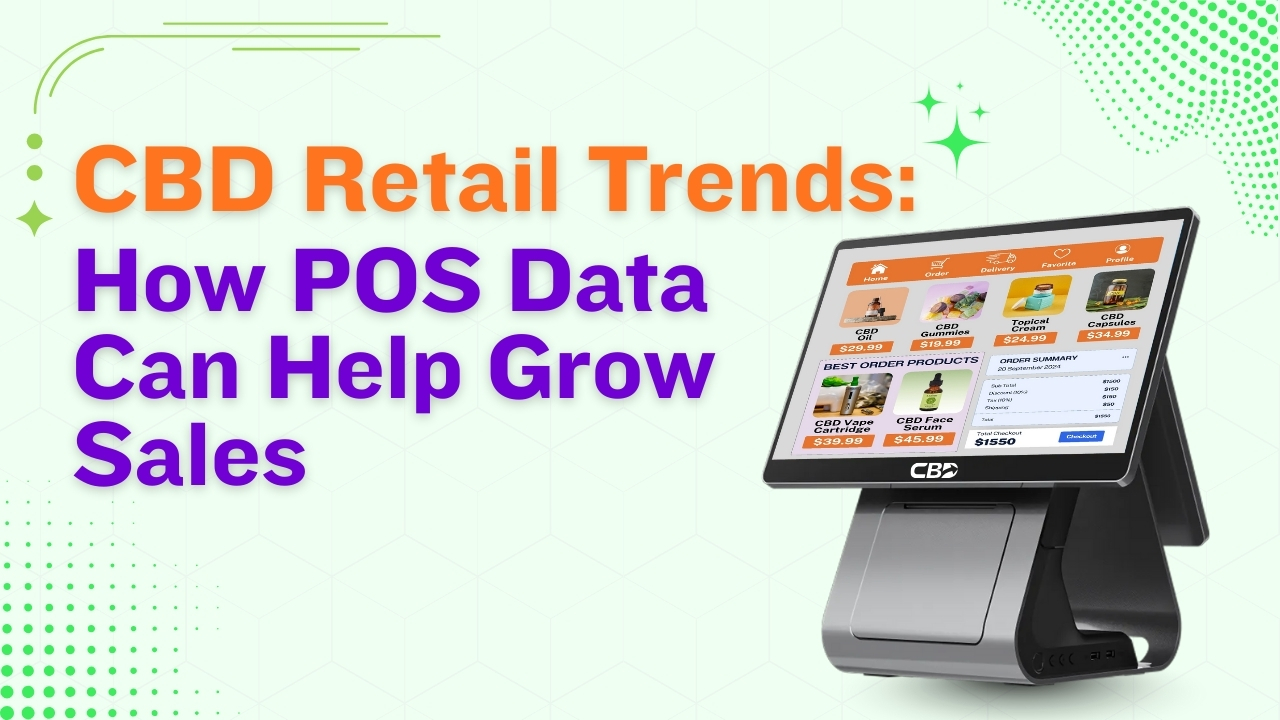
The CBD retail landscape is changing faster than almost any other wellness category. What began as a niche market of tinctures and topicals has evolved into a highly competitive environment full of minor cannabinoids, functional blends, infused beverages, pet products, THCA flower, and fast-moving regulatory updates.
As consumer expectations shift toward transparency, education, personalized recommendations, and seamless omnichannel experiences, CBD retailers must adapt quickly to stay relevant and profitable. In this dynamic landscape, POS data has become one of the most powerful tools for driving CBD sales and operational efficiency.
A modern CBD POS system is no longer just a checkout tool; rather it’s the engine that powers compliance, inventory accuracy, customer engagement, and strategic decision-making.
By tracking real-time sales data, product performance, subscription trends, batch-level COA insights, and customer behavior, retailers can identify what is working and identify emerging CBD retail trends and eliminate guesswork. This is important in a category where CBD compliance, shipping restrictions, potency variations, and age verification requirements create constant operational pressure.
POS data also unlocks the ability to personalize shopping experiences, optimize inventory management, prevent oversells, reduce returns, and forecast demand more accurately. Whether you are managing in-store traffic, online orders, or recurring subscriptions, actionable insights from your POS helps you to operate faster and make smarter decisions.
In a crowded market, where the retailers who leverage data and not assumptions are the ones who grow. Through this blog we will break down the biggest CBD retail trends shaping the industry today and explain POS analytics can help CBD stores increase sales, improve retention, streamline operations, and build long-term customer trust.
Also Read: Best Ecommerce Platform for CBD
The State of CBD Retail Today: Why Data Matters More Than Ever
CBD retail has expanded from novelty products on health store shelves into a well-known wellness category having educated customers, growing regulations, and demand for consistency, transparency, and trust.
1. Competition has exploded
CBD shelves and online stores have a lot of brands so just depending on intuition is risky. Without data, you are guessing which products, promos, and channels actually work. A data-driven POS shows you your top SKUs, best customers, peak hours, and highest-ROI campaigns, giving you the insight to refine strategy, focus your budget where it matters, and consistently win against competitors without overspending.
Also Read: Guide to Start a CBD Business
2. Product complexity is rising
Today’s CBD menus are no longer simple, rather it includes CBD sleep formulas, CBG focus blends, multiple strengths, and terpene-rich profiles. A modern POS system tracks every variant, potency, and formulation, so you can quickly see which combinations sell, and where to adjust inventory or pricing.
Also Read: 10 Best Website Builder for CBD Business
3. Regulations shift constantly
States’ rules around inhalables, THC limits, packaging, and age-gating keep changing rapidly. A smart POS system helps to enforce these rules automatically with age verification, restricted SKUs, and location-based controls, reducing the risk of compliance issues, fines, or forced product removals.
4. Consumer expectations are higher
Today’s shopper expects COAs on demand, customized recommendations, smooth and effortless checkout. POS data links purchases to customer profiles, allowing personalized suggestions, education-driven selling, and loyalty programs based on real behavior and not assumptions.
Also Read: Best Ecommerce Platform for CBD
5. Payments remain high-risk
Because of frequent disputes, unclear billing descriptors, and subscription billing issues, CBD transactions face extra scrutiny from banks and processors. A strong POS provides clear records of transactions, products, and customer history, reducing disputes, supporting chargeback responses, and giving processors confidence that their operation is transparent and well-managed.
A modern POS system is the only scalable way to track all this complexity. It acts like the brain of your retail operation collecting data on sales, customer behavior, inventory movement, product performance, and compliance.
Also Read: What is a High-Risk Merchant Account Why CBD Needs One
CBD Retail Trends
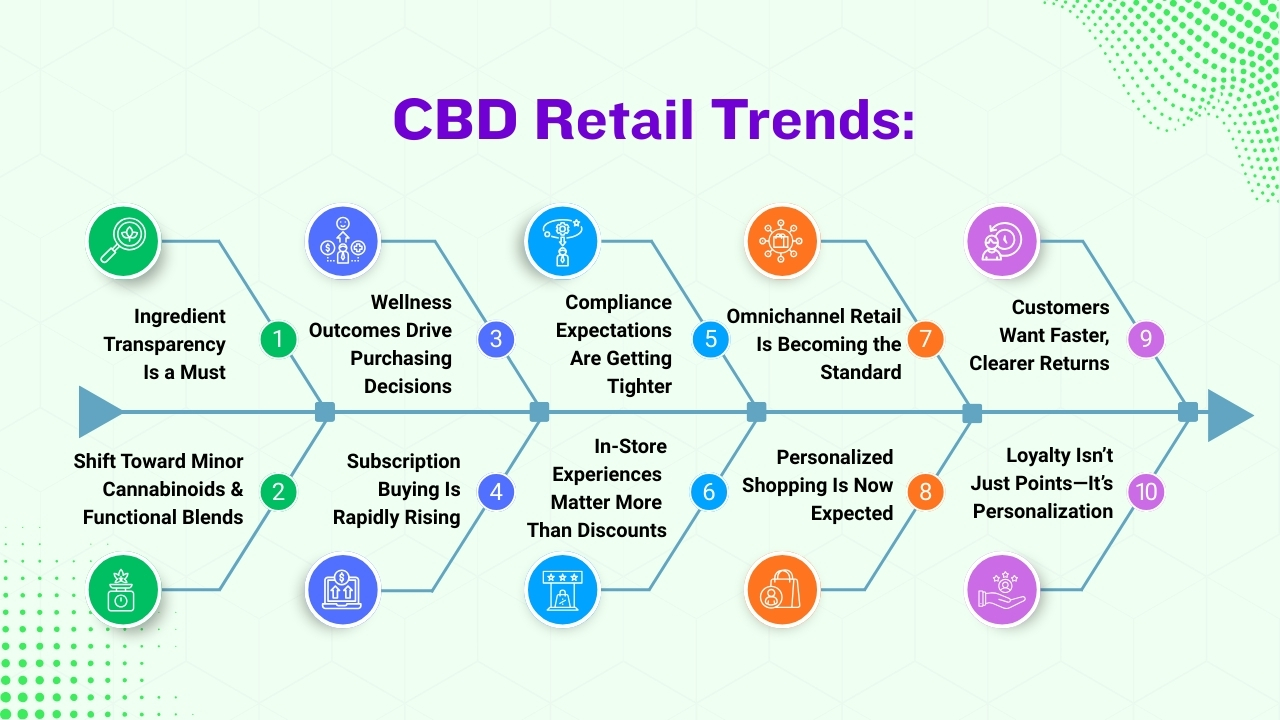
Trend #1: Ingredient Transparency Is a Must
Why Transparency Matters
Today’s CBD shopper wants to know exactly what is inside the bottle. They look for clear details on cannabinoid potency, minor cannabinoids(CBN, CBG), extraction method, terpene profile, source farm, COA results, batch or lot numbers, expiry dates, and which lab tested the product. In the wellness world, this level of clarity is the minimum standard to have.
How POS Data Helps
A CBD-aware POS links every SKU and lot to its COA, tracks expiry dates, and can add QR codes to receipts or labels so customers instantly view lab results and product details. This builds trust right at the point of sale or checkout counter.
Growth & Buying Impact
With this data, retailers get to know which batches drive stronger effects and higher repeat purchases, and which terpene profiles underperform. That leads to:
- Higher conversion and fewer “didn’t feel anything” returns
- Fewer product questions at the counter
- Smarter future purchasing and stronger brand loyalty
Most importantly, it supports smarter, evidence-based buying decisions and tighter product curation, which strengthens brand loyalty and keeps customers coming back for the products that genuinely work for them.
Also Read: How Much Does It Cost to Open a CBD Dispensary
Trend #2: Shift Toward Minor Cannabinoids & Functional Blends
What’s Changing
CBD customers are no longer satisfied with “just CBD.” Rather they are actively seeking targeted formulas like CBN for sleep, CBG for focus or gut health, THCV for appetite control, microdosed Delta-8/Delta-9, and functional blends with L-theanine, melatonin, or chamomile. CBD menus now look like a targeted “functional pharmacy”rather than a basic wellness shelf.
How POS Data Helps
A smart POS system lets you tag and filter products by:
- Cannabinoid profile(CBD, CBN, CBG, THCV, blends)
- Ratios(CBD:CBN, CBD:CBG, 1:3:1 blends)
- Intended effect(sleep, calm, focus, recovery, pain)
- Form factor(gummies, tinctures, vapes, capsules, topicals).
From there, you can run reports like:
- “Top-selling minor cannabinoid products”
- “Repeat rate: CBN gummies versus CBD gummies”
- “Aging inventory: CBG tinctures”
Growth Impact
By aligning your buying, shelf space, and marketing with real demand instead of instincts, every part of your CBD display works harder and drives more revenue, repeat purchases, and long-term customer loyalty.
Also Read: How to Start a CBD Oil Business
Trend #3: Wellness Outcomes Drive Purchasing Decisions
From Ingredients to Outcomes
Most CBD shoppers are not focused on ingredient lists rather they are focused on solving an issue. Instead of asking for specific cannabinoids or milligram strengths, they come in wanting help with sleep, stress, recovery, pain relief, focus, mood, or instincts.
These “wellness outcomes” are what truly influence buying decisions. When retailers understand the outcome a customer wants, then they can match them to the right product faster and create a more satisfying and results-driven shopping experience.
How POS Data Helps
A smart POS tags each product by need state like sleep, stress, recovery, relief, focus, mood, or instincts making it easier to match customers with the right solutions.
- You can offer personalized recommendations aligned with specific wellness goals.
- It helps create customer pathways, like a “starter sleep bundle” or “stress relief trio.”
- You gain powerful cross-sell insights, such as “Customers who bought sleep gummies also tried CBN drops.”
- Staff can be trained to sell by desired outcome, not guesswork, improving confidence and customer satisfaction.
Growth Impact
When you sell by wellness outcome, customers feel understood and see better results. It leads to:
- Higher average order value(AOV) from smart bundles and add-ons
- Stronger repeat purchase because products match real-life needs
Also Read: Understanding CBD Payment Terms
Trend #4: Subscription Buying Is Rapidly Rising
Why Subscriptions Matter
Wellness results come from consistency and not one-time use. Once CBD customers find a product that really works whether it’s a sleep gummy, stress tincture, or pet formula then consumers prefer to put it on an automatic monthly subscription rather than worrying about running out.
Where Subscriptions Are Growing
Subscriptions are growing across:
- Gummies and tinctures
- Softgels and topicals
- Pet CBD products
- THCA or Delta-8 flower
How POS Data Helps
A subscription-aware POS system shows:
- Churn rate and average subscription length
- Top reasons for cancellation
- Lapsed subscribers you can win back
- Products with the highest subscription adoption
The strongest trust signal is simple: give customers self-serve cancellation so they can pause or stop anytime, which naturally reduces down on disputes and chargebacks.
Growth Impact
Strong subscription programs convert one-time buyers into steady monthly revenue, giving CBD retailers predictable cash flow, better inventory planning, and deeper long-term loyalty from customers who build their wellness routine around trusted, automatically reserved products.
Also Read: How Zero Works for CBD Business
Trend #5: Compliance Expectations Are Getting Tighter
Why Compliance Is Increasingly Complex
CBD retailers face rising state-level regulations around age limits, shipping restrictions, allowed SKUs especially vapes and ingestibles, THC thresholds, labeling rules, COA visibility, expiry timelines, packaging standards, and synthetic cannabinoids. One rule change can impact multiple CBD products overnight.
How POS Data Helps
A CBD-aware POS simplifies compliance by:
- Automatically blocking restricted SKUs by state or ZIP code
- Performing built-in ID verification for age-gated products
- Enforcing carrier-specific shipping rules
- Tracking batch, lot, and expiry dates
- Storing COAs and linking them to products
- Printing compliant labels with required warnings
- Generating audit-ready logs to satisfy regulators
Growth Impact
When compliance is handled automatically, retailers avoid seizures, returns, fines, frozen shipments, and even forced shutdowns. This protection preserves revenue, protects brand reputation, and ensures customer trust allowing the business to grow confidently without fear of regulatory surprises.
Also Read: Kratom and CBD Key Difference in Payment Regulations
Trend #6: In-Store Experiences Matter More Than Discounts
Why Experiences Beat Discounts
Today’s CBD shoppers are not looking for the lowest price; rather they want clarity, confidence, and a professional and wellness-first environment. They don’t want a smoke-shop feel rather they want a calm, guided experience that helps them choose the right products for their needs.
Top In-Store CBD Experiences
- Short quizzes that match shoppers to products based on their needs, like sleep, stress, recovery, or focus.
- Staff-guided product education in simple and non-technical language
- Interactive kiosks that suggest products and bundles
- Aroma sampling for terpene profiles
- Hands-on topical trials for pain and recovery
How POS Data Helps
- Tracks time of day with the highest conversion
- Highlights associates with the best attach-rate and upsells
- Identifies products with the strongest first-time conversion
- Shows which experiences drive repeat purchases
- Makes staff training data-guided, focusing on what top performers do best
Also Read: Best Ecommerce Platform for CBD
Trend #7: Omnichannel Retail Is Becoming the Standard
Why Omnichannel Matters
CBD shoppers want flexibility. Some consumers prefer browsing in-store, others buy online, reorder via SMS, or use curbside pickup and local delivery. Many consumers also discover products on social media and expect an easy path to purchase no matter where they start.
Where Customers Shop
- In-store
- Online store
- Curbside pickup
- Local delivery
- Social media (Instagram, TikTok, etc.)
- SMS reorder links and reminders
How POS Data Helps
A smart POS system becomes your central hub by offering:
- One real-time inventory ledger across all channels
- Unified order history for every customer whether they buy in-store or online
- Cross-channel loyalty and rewards, so loyalty points and rewards follow customers everywhere they shop
- Digital receipts with COA links for trust and compliance
- Integrated shipping rules to stay compliant with state laws and carrier
Growth Impact
Offering multiple ways to buy CBD products improve total revenue, reduces stockouts and accidental oversells, and gives customers a smoother and more consistent experience whether they shop in-store, online, for pickup, local delivery, or subscription reorders.
Also Read: CBD POS Systems 7 Must have features for Dispensaries
Trend #8: Personalized Shopping Is Now Expected
What Shoppers Expect
Today’s CBD customers don’t want generic suggestions. They expect recommendations based on:
- Their need states(sleep, stress, pain, focus, mood, gut health)
- Previous purchases and what actually helped
- Cannabinoid preferences(CBD, CBN, CBG, THCV, Delta-8)
- Dosage tolerance and product strength
- COA patterns(for instance, terpene profiles they respond well to)
- Review or feedback history
- Age and permissioned communication preferences
How POS Data Helps
A modern, CBD-aware POS quietly builds rich customer profiles, including:
- Opt-ins and communication channels like SMS, email
- Stated preferences and goals
- Past purchases, returns, and reactions
- Notes from staff conversations
- Subscription behavior and reorder patterns
Why It Matters
This data powers hyper-personalized marketing and in-store guidance, so every text, email, and recommendation feels customized, increasing conversion, satisfaction, and long-term loyalty.
Also Read: How Much Does an Average CBD Store Make
Trend #9: Customers Want Faster, Clearer Returns
Why Returns Matter More in CBD
CBD returns are extra sensitive because customers judge you on both product experience and service. Common issues include:
- Efficacy concerns (“didn’t feel anything”)
- Taste or texture problems
- Packaging or leakage issues
- Melting gummies or heat damage
- Shipping delays or damages
- Mislabeling or confusion about strength
How POS Data Helps
A smart POS makes CBD returns faster and clearer by collecting structured data for every case.
- It records reason codes for each return(taste, effect, damage, melt, delay)
- Photo evidence can be attached directly to the return ticket for documentation.
- It records batch and lot numbers, supporting quality control and vendor follow-up
- Tracks staff involvement and prior return history to identify patterns or potential abuse
- Enables instant store credit options, keeping revenue in-house while still keeping customers satisfied.
Growth Impact
When your return process is clear, documented, and data-backed, you see fewer chargebacks, have stronger relationships with payment processors, and happier customers who feel their issues are handled quickly, fairly, and with real attention and care.
Also Read: How to Create an Effective CBD Business Plan
Trend #10: Loyalty Isn’t Just Points—It’s Personalization
From Generic Points to Real Loyalty
A traditional loyalty program says, “Buy X, earn Y points.” In the CBD that is not enough. As shoppers want programs that recognize their needs, habits, and wellness goals, and not just their receipts. The strongest loyalty programs reward people in ways that feel personally relevant and genuinely helpful.
What Modern CBD Loyalty Looks Like
The best programs focus on:
- Need-state rewards (extra points on sleep, stress, or recovery lines)
- Personalized recommendations based on past purchases and outcomes
- Tier-based perks (VIP sleep tier, recovery tier, pet-care tier, etc.)
- Birthday or wellness milestones
- COA-driven suggestions linked to preferred terpene or cannabinoid patterns
- Local event invites for education nights, sampling events, or VIP drops
How POS Data Helps
POS analytics reveal:
- Which customers respond to which rewards (discounts, samples, points, early access)
- What triggers a second purchase (bundles, education, follow-up messages)
- Which loyalty tiers are truly profitable
- When customers are likely to lapse, so you can reach out with the right offer at the right time
Practical Ways to Use POS Data to Grow Sales
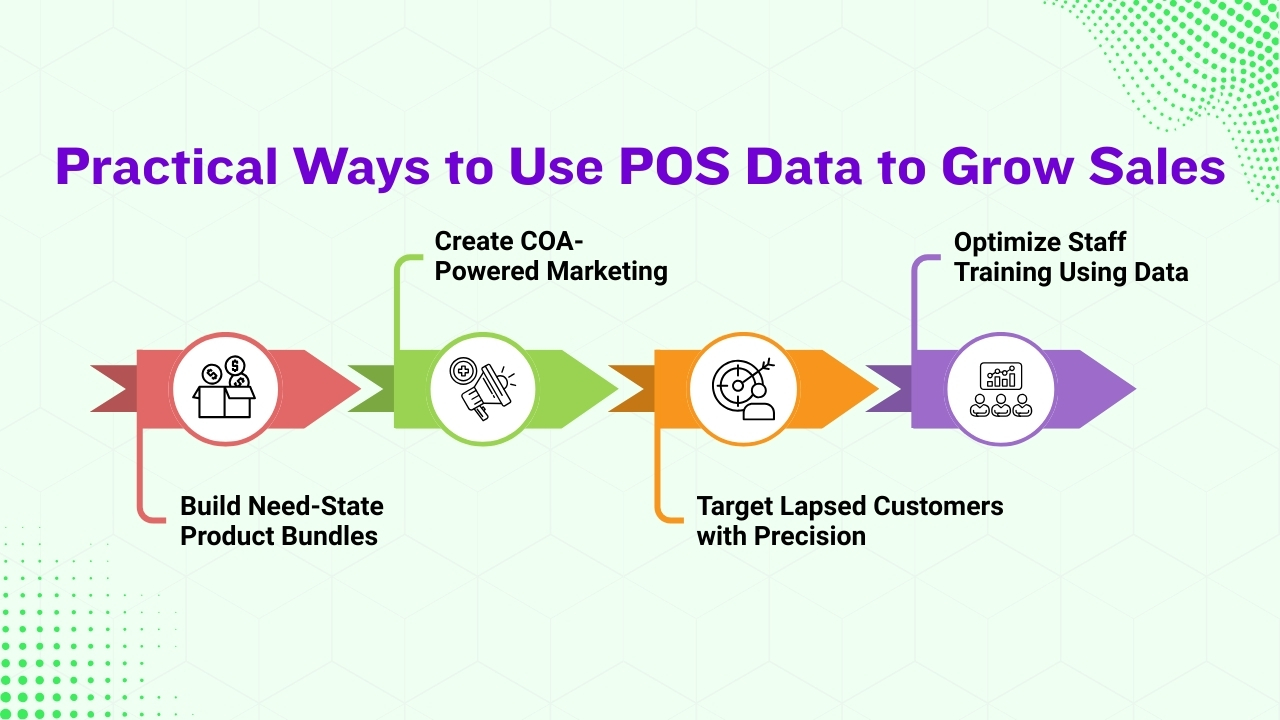
Below are real, actionable strategies that CBD retailers can start using right now to grow sales.
1. Build Need-State Product Bundles
Your POS already tracks which products are most commonly purchased together in the same transaction. Maybe someone buys sleep gummies, and a few minutes later, comes back for a tincture. Or consumers who buy a recovery balm often pair it with capsules. That’s not random, rather that’s your customers telling you what “solutions” they see as complete.
Use this data to build need-state bundles around real goals:
- Sleep kits (CBN gummies + nighttime tincture + calming tea or topical)
- Stress bundles (daytime calm tincture + evening gummy + aromatherapy roll-on)
- Relief packs (targeted balm + recovery capsules + cooling roll-on)
- Starter kits (low-dose sampler of gummies, tincture, and softgels)
Price the bundles like a small upgrade with a little savings so customers can say “yes” easily. Promote these bundles on end caps, near the checkout, and on your website. Train your staff to ask,”Do you want a sleep kit or just the gummies?” rather than selling single items every time.
It increases average order value(AOV) instantly and gives customers better and more holistic solutions so they are happier and more likely to come back.
Also Read: State by State Guide to Selling CBD Online and In-Store
2. Create COA-Powered Marketing
Your COAs are not just compliance documents rather they are marketing effectively when combined with POS data. Primarily use your POS to identify which batches have the highest repeat purchase rates and the fewest returns or complaints. You will quickly identify patterns like:
- “Batches with higher myrcene and linalool have better sleep feedback.”
- “This CBD:CBN ratio drives more repeat purchases than others.”
- “These lab partners consistently produce top-performing batches.”
Once you know your best COA batches, feature them in your marketing:
- Highlight lab accuracy and consistency across that batch.
- Highlight richer terpene levels or specific terpene blends that are linked to desired effects like calm, focus, or recovery.
- Emphasize consumer-preferred cannabinoid ratios based on actual repeat behavior.
Use in-store signage, email campaigns, SMS texts, and even QR codes linking directly to COAs. You are no longer just asking customers to “trust us” and you’re backing your claims with lab results and real repeat-purchase data side by side.
Also Read: CBD Content Marketing
3. Target Lapsed Customers with Precision
Most CBD retailers know customers eventually stop buying but they don’t know exactly when or why but your POS does.
Begin by creating simple cohorts based on what customers bought:
- Sleep shoppers
- Stress shoppers
- Pain/relief shoppers
- Pet CBD shoppers
- Vape or flower shoppers
Then, use your POS data to see when those groups usually lapse. Maybe sleep shoppers stop buying them around 45-60 days, and pet customers around 90 days. That timing window becomes your secret advantage.
Now develop win-back campaigns that activate before customers fully drop off:
- Offers – “We’ve got something special for your next sleep purchase.”
- New functional blends – “You loved X, we just added Y that might work even better.”
- Subscription discounts – “Lock in your routine and save 10% monthly.”
- Reminder messages – “We saved your favorite product—ready for a refill?”
Ensure you make these messages need-state specific and not generic. Sleep consumers get sleep-focussed reminders while pet owners get pet-focused messages.
Result : lower churn rates, higher lifetime value, and more one-time buyers turning into steady repeat customers, because you reach them with the right offer at the right time instead of blasting generic discounts everywhere.
4. Optimize Staff Training Using Data
Your team is your front line, and your POS system quietly tracks how each associate performs, showing who converts best, who adds the most items, which categories they sell well, and where coaching is needed, so training becomes targeted rather than based on guesswork.
Track metrics such as:
- Attach-rate – how often they add an extra product or bundle to a sale.
- Average basket size – total revenue per transaction.
- Conversion – how often a serious inquiry leads to a purchase.
- Product category success – which associates excel in sleep, stress, relief, pets, or topicals.
Rather than guessing who is “good with customers”, you will see clear patterns. From there, staff training becomes targeted:
- Study your top performers and capture their behaviors like questions, explanations, how they use COAs, how they suggest bundles or subscriptions.
- Turn those behaviors into training scripts and roleplays for the rest of the team.
- Set realistic improvement goals for underperformers: maybe focus on attach-rate first, then average basket size.
- Use incentives and recognition linked to quality metrics, not just sales volume.
You can even use POS data to identify training gaps, for instance, if staff rarely sell CBN or CBG maybe they need more education or an easier script to explain minor cannabinoids.
Result: You get more consistent, and confident selling across your team, higher conversion, larger baskets, and a better customer experience empowered by real performance data and not guesswork.
Conclusion
At the end of the day, CBD retail is not just about stocking shelves and hoping the right customers to walk in. It’s about understanding what those customers need, which products actually deliver results , and how every part of your operation like inventory, staff, marketing, compliance, and payments works together. That is what a modern, data-driven POS unlocks.
Rather than guessing which gummies to reorder, which bundles to promote, or which campaigns are working, you can see it clearly in the numbers. You know which COA batches drive repeat purchases, which need states like sleep, stress, relief, focus are growing and when customers tend to lapse. You are able to build smarter bundles, reduce waste with FEFO, design real loyalty and not just points, and turn returns and subscriptions into strengths.
Most importantly POS data helps you create the kind of experience today’s CBD shopper expects to be transparent, personalized, compliant, and genuinely helpful. As regulations tighten and competition increases, the retailers who win won’t be the ones with the best discounts rather they will be the ones with clearest insight.
If you consider your POS as the brain of your CBD business, not just a checkout tool, you transform data into everyday decisions that grow revenue, protect margins, and earn long-term loyalty, one informed transaction at a time.
If you still have any query with CBD Retail trends then feel free to write to us at CBD Merchant Solutions and we are more than happy to assist you.
Frequently Asked Questions(FAQs)
1. Can POS data help reduce waste and expired inventory?
Yes. When your POS tracks expiry by batch and lot, then you can use FEFO(First Expiry, First Out) logic and alerts to identify products that are approaching expiry. Accordingly you can plan flash sales, bundles, and targeted promotions to move older stock first.
2. Can POS data really help with CBD compliance?
Yes. A good POS can be a great compliance asset as it blocks restricted products by state, enforce age checks, track THC thresholds by SKU, store COAs, and generate audit-ready logs for regulators or banking partners. It automates a lot of the compliance logic at checkout reducing the risk of seizures, fines, or account shutdowns.